The short answer on longevity blood tests
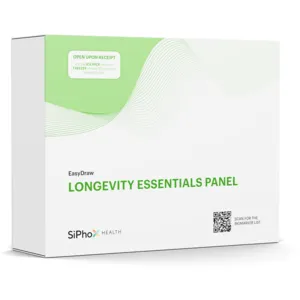
"Longevity blood test" is a marketing term, not a medical one. Stripped of hype, it means testing the blood markers that best predict heart disease, diabetes, kidney and liver disease, the conditions that cut most healthy years short. The ones with guideline-level evidence are ApoB, Lp(a), HbA1c, eGFR and a standard lipid panel, with hs-CRP, liver enzymes, ferritin and hemoglobin close behind. SiPhox Longevity Essentials covers ApoB, Lp(a), HbA1c, hs-CRP, ferritin and hemoglobin at home for $124 plus $25 shipping. Its Heart & Metabolic panel swaps in kidney and liver markers, and Ultimate 360 has all of them.
Longevity markers, ranked by the strength of evidence
We grouped markers by what the major guidelines say, not by what longevity clinics sell. Blood pressure, waist size, fitness and smoking status matter as much as any of these, but they are not blood tests, so they sit outside this table. "Guideline" means a US or international clinical guideline recommends measuring it in at least some adults.
| Marker | Why it matters for healthy aging | Evidence |
|---|---|---|
| ApoB | Counts the particles that build artery plaque; added to US guidance in the 2026 ACC/AHA dyslipidemia guideline | Guideline |
| Lp(a) | Mostly inherited heart and stroke risk; measure at least once in every adult per the 2026 ACC/AHA guideline and the NLA | Guideline |
| Lipid panel | LDL, HDL, triglycerides and non-HDL; the basis of heart risk scores | Guideline |
| HbA1c | 3-month blood sugar average; catches prediabetes (5.7% to 6.4%) years before diabetes | Guideline |
| eGFR and creatinine | Kidney filtering; under 60 for 3 months signals chronic kidney disease, which raises heart risk | Guideline |
| hs-CRP | Low-grade inflammation; CDC/AHA bands: under 1 mg/L lower risk, over 3 mg/L higher | Strong, used to refine risk |
| ALT and GGT | Liver cell damage and fatty liver, closely tied to insulin resistance | Strong |
| Cystatin C | Kidney marker less affected by muscle mass than creatinine | Strong |
| Ferritin and hemoglobin | Iron stores and anemia; both too low and too high are problems | Strong for diagnosis |
| Fasting insulin / HOMA-IR | Early insulin resistance before A1C rises | Moderate; no standard cut-off |
| Testosterone, TSH | Useful when symptoms point to them | Diagnostic, not screening |
| Vitamin D | Deficiency matters for bone health | Mixed; routine testing not advised for healthy adults under 75 |
Reference points for the core markers
Each marker needs a number to read it against. These are the guideline cut-offs this page uses; your lab's printed range may differ, so check your own report.
| Marker | Reference point | Units | Source |
|---|---|---|---|
| ApoB | Under 90 desirable, 130 or more high | mg/dL | Harvard Health |
| Lp(a) | Above about 125 raises risk meaningfully | nmol/L | NLA 2024 |
| HbA1c | Under 5.7 normal, 5.7 to 6.4 prediabetes, 6.5 or more diabetes range | % | NIDDK |
| eGFR | 90 or more normal; under 60 for 3 months signals kidney disease | mL/min/1.73m² | National Kidney Foundation |
| hs-CRP | Under 1 lower risk, 1 to 3 average, over 3 higher | mg/L | CDC/AHA |
Source: CDC/AHA scientific statement, Circulation 2003. Results above 10 mg/L usually reflect infection or injury and should be repeated, so the chart stops at 10. Average two tests about two weeks apart.
Which services test each longevity marker
This table is built from each panel's published biomarker list (checked September 29, 2026).
| Marker | SiPhox Longevity | SiPhox Heart & Met | SiPhox Ultimate 360 | Rythm Health |
|---|---|---|---|---|
| ApoB | Yes | Yes | Yes | Yes |
| Lp(a) | Yes | Yes | Yes | No |
| Lipid panel | Yes | Yes | Yes | Yes |
| HbA1c | Yes | Yes | Yes | No (fructosamine) |
| C-peptide | Yes | Yes | Yes | No |
| eGFR | No | Yes | Yes | Yes |
| hs-CRP | Yes | Yes | Yes | Yes |
| ALT | No | Yes | Yes | No |
| GGT | No | No | Yes | Yes |
| Cystatin C | No | No | No | No |
| Ferritin | Yes | No | Yes | Yes |
| Hemoglobin | Yes | Yes | Yes | Men only |
| Vitamin D | Yes | No | Yes | Yes |
| TSH | Yes | Yes | Yes | Yes |
| Testosterone | Yes | No | Yes | Yes |
The pattern is clear. Longevity Essentials is strongest on heart and metabolic risk but has no kidney or liver markers. Heart & Metabolic adds eGFR, creatinine, ALT and AST but drops vitamin D, ferritin and hormones. Ultimate 360 covers everything on this list except cystatin C, for $249 plus shipping. Because you can switch SiPhox panels every test, alternating Longevity and Heart & Metabolic covers most of the list at the base price.
The lab-draw memberships go wider. Superpower's published panel includes ApoB, Lp(a), hs-CRP, cystatin C, eGFR, ALT, GGT, ferritin, vitamin D and homocysteine across 150+ markers a year for $349. Function Health covers 160+ tests a year for $365. Both need a venous draw at Quest; see SiPhox vs Function Health for the trade-off.
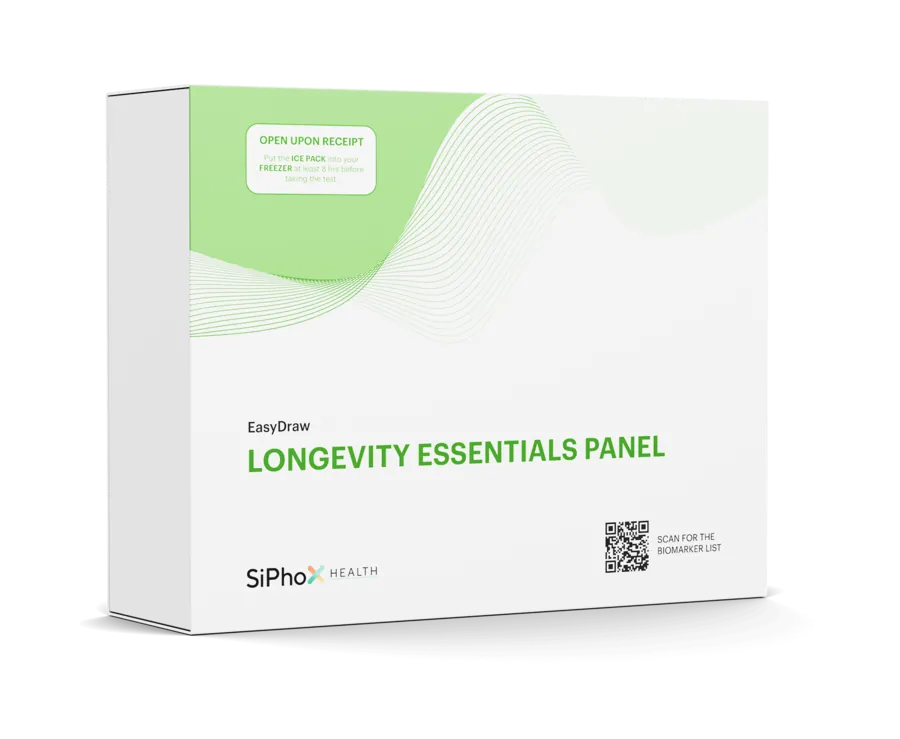
Longevity Essentials
The default panel: heart, metabolic, hormone and inflammation markers in one draw.
Check price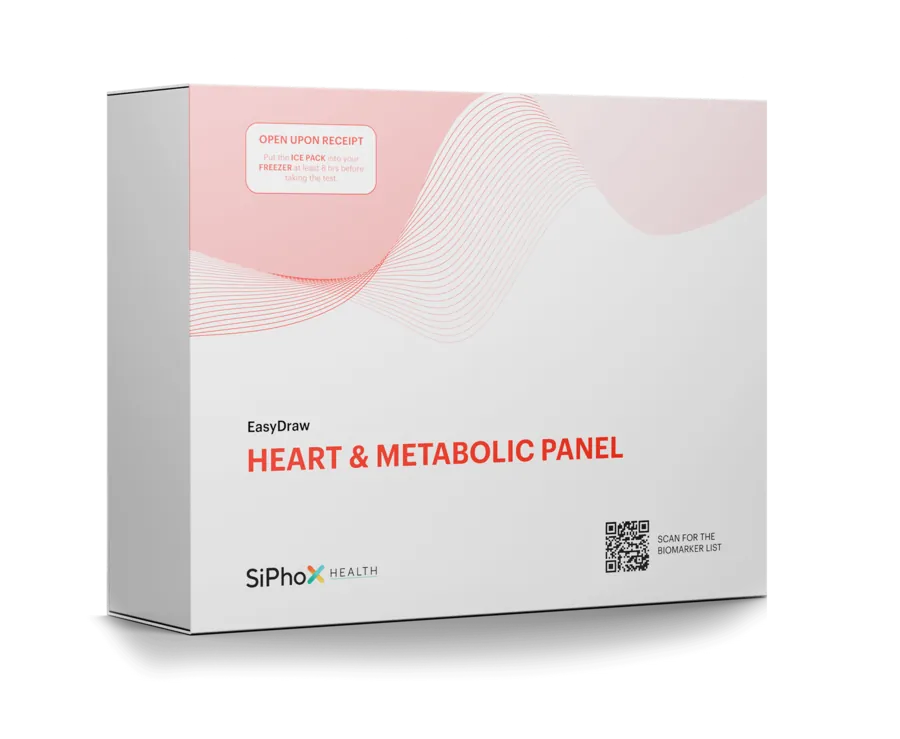
Heart & Metabolic
Lipids plus kidney and liver function: the panel for cardiovascular and metabolic risk.
Check price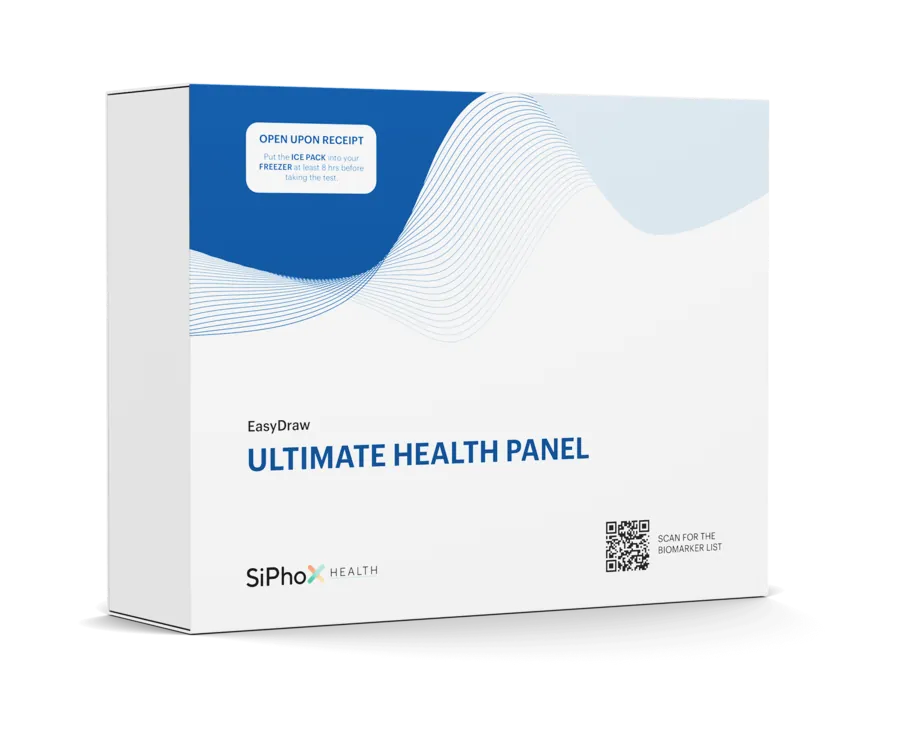
Ultimate 360
Everything on the four core panels plus iron studies, B12 and folate, GGT and PSA.
Check priceWhat SiPhox Longevity Essentials leaves out
To be clear about the gaps: the default SiPhox panel has no kidney or liver markers, no fasting insulin or HOMA-IR, no cystatin C, no homocysteine, no full blood count and no omega-3 index. Kidney and liver markers are on Heart & Metabolic and Ultimate 360. A complete blood count is a +$45 add-on and IGF-1 a +$70 add-on on EasyDraw panels. If fasting insulin is a priority, see our insulin resistance test guide, because no current SiPhox EasyDraw panel measures it; SiPhox reports C-peptide and the triglyceride to HDL ratio instead.
Popular longevity markers with weaker evidence
- Vitamin D. The Endocrine Society's 2024 guideline suggests against routine vitamin D testing in healthy adults under 75, because there is no evidence that routine testing improves outcomes. It still makes sense if you have risk factors for deficiency. See our vitamin D test guide.
- Biological age scores. Several services compute a "biological age" from standard markers. They are interesting to track but none is validated as a target for treatment.
- Homocysteine. Often sold as a longevity marker. Superpower includes it; SiPhox's current EasyDraw panels do not.
- Huge panels. Testing 150 markers raises the chance of a false alarm. More markers are not better unless you would act on them.
Questions to ask before you buy any longevity panel
- Does it include ApoB and Lp(a)? If not, it is missing the two heart markers with the newest guideline support.
- Does it include kidney and liver markers? eGFR and ALT are cheap and informative; some at-home panels skip them.
- Who reviews the results? SiPhox and Rythm do not include a doctor review; Function Health adds clinician notes.
- Can you retest just the markers you are changing? Paying for 150 markers to track three is poor value.
- What does a year cost with shipping and add-ons, not just the headline price?
- Is it available where you live? SiPhox does not serve New York or Hawaii, and some lab-draw services charge more in New York and New Jersey.
A sensible longevity testing plan
- Baseline once: the full list above, including Lp(a), which usually only needs measuring once in a lifetime. Ultimate 360 or a lab-draw membership does this in one go.
- Track what you can change: ApoB, HbA1c, hs-CRP and liver enzymes respond to diet, exercise, weight and medication. Retest every 3 to 6 months while you are making changes, then once or twice a year.
- Act through your doctor: none of these services diagnose disease. Take anything outside the reference range to your doctor, and ask for a standard venous test to confirm it.
What a year of longevity testing costs
Here are four realistic plans, priced with shipping at September 29, 2026 list prices. SiPhox's first test for new members is advertised at $99 plus shipping, which would take $25 off the first year.
| Plan | What you get | Cost a year | Needle? |
|---|---|---|---|
| SiPhox, twice a year | Longevity Essentials, then Heart & Metabolic | $298 | No |
| SiPhox, quarterly alternating | Longevity and Heart & Metabolic, two of each | $596 | No |
| SiPhox, full baseline plus tracking | Ultimate 360 once, then Longevity Essentials three times | $721 | No |
| Superpower | 150+ markers across a baseline and a retest | $349 | Yes, Quest draw |
| Function Health | 160+ tests across two draws | $365 | Yes, Quest draw |
If you only want breadth once a year, a lab-draw membership is cheaper. If you want to see ApoB, HbA1c and hs-CRP move while you change something, or you will not go to a lab, SiPhox is the better fit. Our cost calculator runs other combinations, and the best at-home blood test ranking compares all six services.
Our arithmetic from list prices checked 29 Sep 2026, SiPhox with $25 shipping per test: $274 + 3 x $149 = $721; 4 x $149 = $596; 2 x $149 = $298.
Take Maria, 45, who has never had Lp(a), kidney or liver markers checked and wants to track ApoB and HbA1c while she changes her diet. She starts with Longevity Essentials at the $124 first-test price, retests with Longevity Essentials twice at $149, and uses one quarterly slot for Ultimate 360 at $274 to pick up eGFR, ALT, GGT, iron studies, B12 and the full thyroid set: $124 + $149 + $149 + $274 = $696 in year one, or $721 at list price. That is 31 + 31 + 31 + 62 = 155 marker results, or about $4.49 each. In year two, if everything is stable, dropping to twice a year costs $298. Anything out of range goes to her doctor first.
Which longevity test to choose
| If you want | Choose | Why |
|---|---|---|
| The widest single snapshot, and a needle is fine | Function Health or Superpower | 150 to 160+ markers a year for $349 to $365, about $2.30 per marker |
| Cystatin C or homocysteine | Superpower | Both on its published panel; not on SiPhox EasyDraw panels |
| A full baseline without a lab visit | SiPhox Ultimate 360 | 62 markers, $274 with shipping, $4.42 per marker |
| Kidney and liver checks alongside heart markers | SiPhox Heart & Metabolic | eGFR, creatinine, ALT and AST with ApoB and Lp(a) |
| ApoB, HbA1c and hs-CRP tracked every 3 months | SiPhox Longevity Essentials | 31 markers, $149 a test with shipping, switch panels each test |
Reading trends, not single results
Every lab result has some normal variation: the same person tested twice in a week will not get identical numbers. hs-CRP is the best example; the CDC/AHA statement recommends averaging two measurements taken about two weeks apart and ignoring a result above 10 mg/L, which usually means an infection or injury rather than chronic inflammation. So:
- Look for direction over two or three tests, not a single jump.
- Keep conditions the same: time of day, fasting or not, no hard workout or illness in the days before.
- Stick with one service for tracking. Different labs use different methods and ranges, which can look like a change when nothing changed.
- Separate "out of range" from "trending the wrong way". The first needs a doctor; the second is a prompt to look at what changed in your routine.
Frequently asked questions
What is the best blood test for longevity?
One that covers ApoB, Lp(a), a lipid panel, HbA1c, eGFR, hs-CRP and liver enzymes. SiPhox Ultimate 360 covers all of these at home; Longevity Essentials covers the heart and metabolic core for $124 plus $25 shipping.
How often should I get a longevity blood test?
A full baseline once, then the markers you are trying to change every 3 to 6 months, and once or twice a year when stable. Lp(a) usually needs testing only once.
Is a longevity blood test worth it?
The core markers are worth knowing because several, such as ApoB and Lp(a), are not on a routine physical. Very large panels add cost and false alarms without adding much.
Does insurance cover longevity blood tests?
Consumer longevity panels are not billed to insurance, but most accept HSA and FSA cards. Your doctor can order many of the same markers, which insurance may cover.
Sources
- 2026 ACC/AHA multisociety guideline on the management of dyslipidemia, Circulation (March 2026)
- National Lipid Association 2024 focused update on lipoprotein(a), J Clin Lipidol
- Harvard Health: Is an apoB test a better way to check your cholesterol?
- NIDDK (NIH): The A1C test and diabetes
- CDC: A1C test for diabetes and prediabetes
- National Kidney Foundation: Estimated glomerular filtration rate (eGFR)
- CDC/AHA statement: Markers of inflammation and cardiovascular disease, Circulation 2003
- MedlinePlus: C-reactive protein (CRP) test
- MedlinePlus: Liver function tests
- MedlinePlus: Ferritin blood test
- Endocrine Society: Vitamin D for the prevention of disease, J Clin Endocrinol Metab 2024
- Superpower: biomarkers and membership (checked 29 Sep 2026)
- Function Health: pricing (checked 29 Sep 2026)
- Rythm Health: biomarkers tested (checked 29 Sep 2026)
- SiPhox Health: Longevity Essentials panel (checked 29 Sep 2026)
- SiPhox Health: Heart & Metabolic panel (checked 29 Sep 2026)
- SiPhox Health: Ultimate 360 panel (checked 29 Sep 2026)