
Which blood tests show heart disease risk
Cardiovascular disease killed 919,032 people in the US in 2023, one in every three deaths, according to the CDC. A standard lipid panel is the starting point, but several of the most useful risk markers are not on it. The 2018 AHA/ACC cholesterol guideline lists Lp(a), ApoB, hs-CRP and persistently high triglycerides as risk enhancers, and the 2026 ACC/AHA dyslipidemia guideline brought ApoB into US guidance and recommends measuring Lp(a) at least once in every adult.
| Marker | Why it matters | What a result suggests | On SiPhox |
|---|---|---|---|
| LDL cholesterol | The main treatment target | 160 to 189 mg/dL is a risk enhancer; 190 or more usually means treatment | Longevity, Heart & Metabolic, Thyroid Focus, Ultimate 360, GLP |
| ApoB | Counts every artery-clogging particle | 130 mg/dL or more is a risk enhancer; high ApoB with normal LDL is common in insulin resistance | Longevity, Heart & Metabolic, Ultimate 360, GLP |
| Lp(a) | Mostly genetic, invisible on a lipid panel | 50 mg/dL (125 nmol/L) or more is a risk enhancer; test once | Longevity, Heart & Metabolic, Ultimate 360 |
| hs-CRP | Low-grade inflammation in the arteries | 2 mg/L or more is a risk enhancer; repeat if over 10 | Longevity, Heart & Metabolic, Thyroid Focus, Ultimate 360, GLP |
| Triglycerides | Carry remnant cholesterol; mark insulin resistance | 175 mg/dL or more, persistently, is a risk enhancer | Longevity, Heart & Metabolic, Thyroid Focus, Ultimate 360, GLP |
| HDL and non-HDL | Used in every risk calculator | Low HDL raises calculated risk; non-HDL is a goal in the 2026 guideline | Longevity, Heart & Metabolic, Thyroid Focus, Ultimate 360, GLP |
| HbA1c | Diabetes is a major heart risk factor | 6.5% or more is the diabetes range; PREVENT can use A1C | Longevity, Heart & Metabolic, Ultimate 360, GLP |
| eGFR | Kidney function is part of the AHA PREVENT equations | eGFR 15 to 59 (chronic kidney disease) is a risk enhancer | Heart & Metabolic, Thyroid Focus, Ultimate 360, GLP |
| Urine albumin-creatinine ratio | Optional PREVENT input; early kidney damage | Raised values add risk | Not on SiPhox (urine test) |
| Homocysteine | Linked to risk, but not a guideline risk enhancer | Very high values point to B-vitamin or genetic problems | Not on SiPhox |
Guideline risk-enhancing blood levels
Source: Grundy et al., 2018 AHA/ACC cholesterol guideline. hs-CRP of 2.0 mg/L or more and Lp(a) of 125 nmol/L or more are also risk enhancers. Values are thresholds, not targets.
A risk enhancer does not mean you have heart disease. It is a reason for you and your doctor to lean toward prevention, such as a statin, when your 10-year risk is borderline or intermediate. The 2026 guideline keeps this approach and adds treatment goals for LDL and non-HDL, with ApoB to check residual risk once LDL goals are met. Harvard Health describes an ApoB under 90 mg/dL as desirable and 130 or more as high.
Lp(a) deserves special mention. It is largely inherited and does not move much with diet or exercise, so one test usually lasts a lifetime. The National Lipid Association estimates about 1 in 5 people have an elevated level, and almost none of them know, because it is not on a standard panel. Our Lp(a) test guide and ApoB test guide cover where to get each and what they cost.
How doctors use the numbers
- Calculate 10-year risk. The AHA PREVENT equations use age, sex, total and HDL cholesterol, blood pressure, diabetes, smoking and eGFR, with HbA1c and urine albumin as optional extras.
- Add risk enhancers. Lp(a), ApoB, hs-CRP, persistent high triglycerides, family history of early heart disease, and conditions such as chronic kidney disease or menopause before 40.
- Consider a coronary calcium scan when the decision is still unclear. That is imaging, not a blood test.
- Set goals. The 2026 guideline sets LDL goals of under 100, 70 or 55 mg/dL depending on risk.
hs-CRP needs care: the CDC/AHA statement advises averaging two measurements taken two weeks apart and repeating any result over 10 mg/L, which usually means an infection or injury rather than heart risk. See our hs-CRP test guide.
How often to retest heart markers
- Lp(a): once, unless your doctor has a specific reason to repeat it.
- Lipids and ApoB after a change: the 2026 guideline schedules a recheck at 4 to 12 weeks after starting or changing treatment, then every 6 to 12 months.
- hs-CRP: two tests about two weeks apart, averaged, when it is used for risk.
- HbA1c and eGFR: at least yearly if either is borderline.
At SiPhox prices, a baseline plus one recheck three months after a diet change costs $298 with shipping on Heart & Metabolic, and quarterly tracking for a year costs $596.
Worked example: LDL 130, ApoB 110
Illustrative numbers. A 45-year-old man, non-smoker, normal blood pressure, whose father had a heart attack at 58:
| Marker | Result | Reading |
|---|---|---|
| LDL cholesterol | 130 mg/dL | Looks only mildly high on its own |
| ApoB | 110 mg/dL | Borderline to moderately high (Harvard Health: 90 to 129) |
| Lp(a) | 150 nmol/L | Above 125 nmol/L: a risk enhancer |
| hs-CRP | 2.6 mg/L | Above 2: a risk enhancer (repeat to confirm) |
| HbA1c / eGFR | 5.5% / 95 | Normal |
On LDL alone he might be told to come back in five years. With high Lp(a), a raised hs-CRP and a family history of early heart disease, his doctor has three risk enhancers to weigh against his calculated 10-year risk, and may suggest a calcium scan or earlier treatment. None of that is a decision for a home kit, but none of it happens without the numbers. His Lp(a) also means his siblings and children may want a test.
What an at-home test can and cannot do for heart risk
- Measure ApoB, Lp(a), lipids, hs-CRP, HbA1c and eGFR in one draw
- Track LDL and ApoB every few months after a diet change or new medicine
- Find a high Lp(a) that a standard panel would miss
- Diagnose heart disease: a diagnosis needs a clinician, and often imaging
- Measure blood pressure, urine albumin or coronary calcium
- Detect a heart attack: chest pain needs 911, not a kit
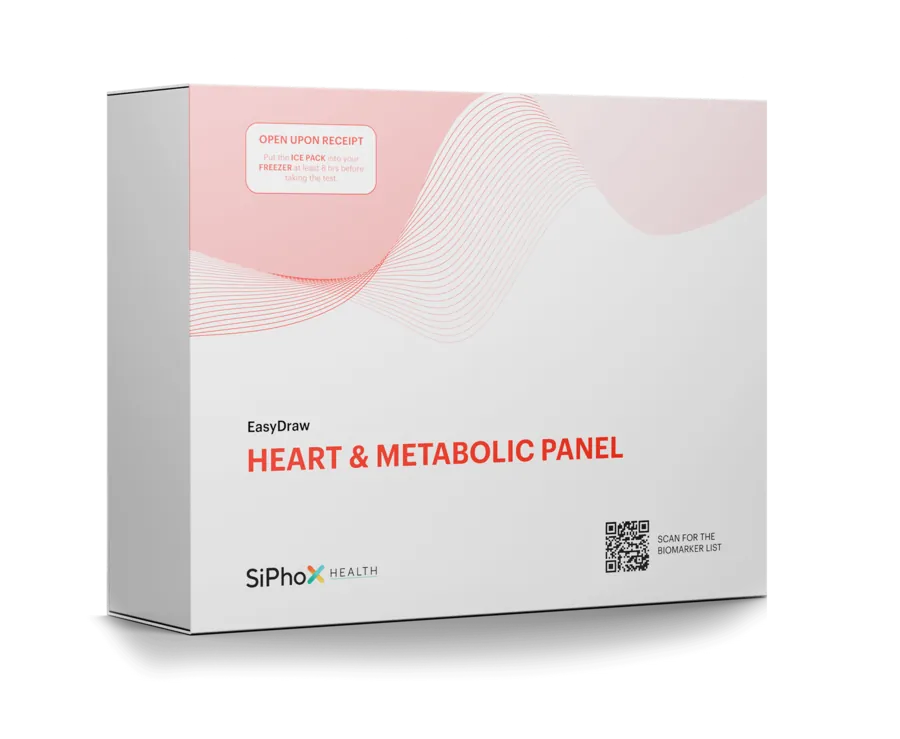
Best-fit SiPhox panel for heart disease risk
| If you want | Test | Choose |
|---|---|---|
| Cardiovascular risk with kidney and liver | ApoB, Lp(a), lipids, hs-CRP, HbA1c, eGFR, ALT, AST | Heart & Metabolic |
| Heart risk plus hormones and vitamin D | ApoB, ApoA1, Lp(a), lipids, hs-CRP, HbA1c, testosterone or female hormones | Longevity Essentials |
| Everything, including thyroid and iron | All of the above plus full thyroid, iron, B12 | Ultimate 360 |
| Homocysteine, urine albumin or a calcium scan | Venous lab, urine test, imaging | Your doctor |
Heart & Metabolic at $124 plus $25 shipping includes eGFR and creatinine, which feed the PREVENT calculator, and liver enzymes, which matter if you start a statin. Longevity Essentials swaps kidney and liver for ApoA1, the ApoB:ApoA1 ratio and sex hormones. SiPhox also lists a one-off Kidney, Liver and Lp(a) panel at $85. For cholesterol basics, see our at-home cholesterol test guide.
Heart & Metabolic
Lipids plus kidney and liver function: the panel for cardiovascular and metabolic risk.
Check price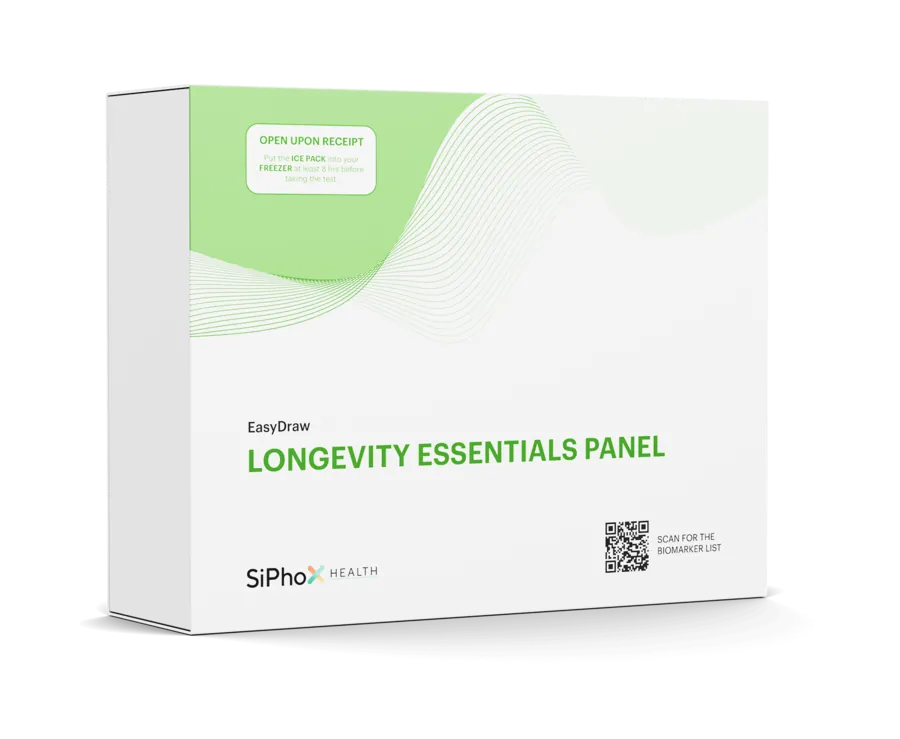
Longevity Essentials
The default panel: heart, metabolic, hormone and inflammation markers in one draw.
Check price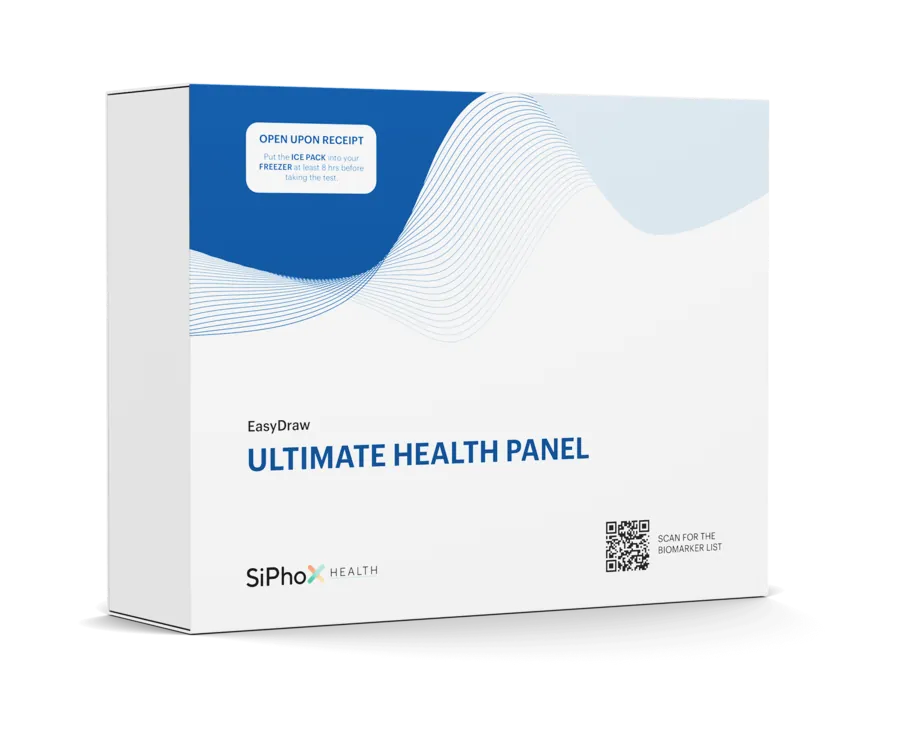
Ultimate 360
Everything on the four core panels plus iron studies, B12 and folate, GGT and PSA.
Check price
Frequently asked questions
What blood test is best for heart disease risk?
No single test. A lipid panel plus ApoB, a one-time Lp(a), hs-CRP and HbA1c gives the most complete picture, and eGFR feeds the AHA PREVENT risk calculator.
Is ApoB better than LDL?
ApoB counts particles, LDL measures the cholesterol they carry. They usually agree; when they do not, especially with high triglycerides or diabetes, ApoB is the better guide to risk.
How often should Lp(a) be tested?
Usually once. Lp(a) is mostly genetic and stable, and the 2026 ACC/AHA guideline recommends measuring it at least once in every adult.
What hs-CRP level indicates heart risk?
2 mg/L or more is a risk enhancer in the 2018 AHA/ACC guideline. Repeat any value over 10 mg/L, which usually reflects infection or injury.
Can a blood test detect a blocked artery?
No. Blood tests estimate risk. Blockages are found with imaging such as a coronary calcium scan or angiogram, ordered by a doctor.
Sources
- CDC: Heart disease facts and statistics
- Grundy SM et al. 2018 AHA/ACC multisociety guideline on the management of blood cholesterol. Circulation 2019
- 2026 ACC/AHA multisociety guideline on the management of dyslipidemia, Circulation (March 2026)
- National Lipid Association 2024 focused update on lipoprotein(a), J Clin Lipidol
- Harvard Health: Is an apoB test a better way to check your cholesterol?
- Khan SS et al. Development and validation of the American Heart Association PREVENT equations. Circulation 2024
- Pearson TA et al. Markers of inflammation and cardiovascular disease: CDC/AHA statement. Circulation 2003
- MedlinePlus: Cholesterol levels
- MedlinePlus: C-reactive protein (CRP) test
- National Kidney Foundation: Estimated glomerular filtration rate (eGFR)
- SiPhox Health: Heart & Metabolic panel (checked 29 Sep 2026)
- SiPhox Health: Longevity Essentials panel and add-ons (checked 29 Sep 2026)
- SiPhox Health: Ultimate 360 panel (checked 29 Sep 2026)