Quick answer
An Lp(a) test measures lipoprotein(a), an LDL-like particle whose level is set mostly by your genes: the American Heart Association puts the inherited share at about 70% to 90% or more. Because it barely changes over a lifetime, one test is usually enough. The 2024 National Lipid Association update recommends measuring it at least once in every adult, and about 1 in 5 people have a raised level.
Risk bands used by Labcorp and the NLA: under 75 nmol/L low, 75 to 124 nmol/L intermediate, 125 nmol/L or more high. You can get it at a Quest or Labcorp site for around $45, or at home from SiPhox Health, either inside a full panel or in an $85 one-off kit.
Who should get an Lp(a) test, per the guidelines
Guidance has moved from "test some people" to "test everyone once":
| Body | Year | What it says |
|---|---|---|
| National Lipid Association (US) | 2024 | Measure Lp(a) at least once in every adult for risk stratification |
| European Atherosclerosis Society | 2022 | Test Lp(a) at least once in adults; cascade testing of relatives in some cases |
| AHA/ACC cholesterol guideline | 2018 | Lp(a) of 50 mg/dL (125 nmol/L) or more is a risk-enhancing factor, especially with a family history of early heart disease |
| American Heart Association statement | 2022 | Lp(a) is a genetically determined, causal and common risk factor |
The people with the strongest reason to test soon are those with a parent or sibling who had a heart attack or stroke young, anyone with heart disease but "normal" cholesterol, people with familial hypercholesterolemia, and relatives of someone already known to have high Lp(a). A standard lipid panel does not include it, so you usually have to ask. More on the marker itself in our lipoprotein(a) guide.
If you are deciding whether to test now or later, it helps to know how the 2018 AHA/ACC guideline uses the result. It lists Lp(a) of 50 mg/dL (125 nmol/L) or more as a risk-enhancing factor next to a family history of early heart disease (a father or brother before 55, a mother or sister before 65), ApoB of 130 mg/dL or more and hs-CRP of 2.0 mg/L or more. Those factors matter most for adults aged 40 to 75 whose 10-year risk estimate is borderline or intermediate, because they can tip the decision on a statin. Testing in your 30s gives you the number before that decision arrives, and because it barely changes, the same result still counts at 55.
Lp(a) results and units
NLA 2024 focused update and Labcorp test 120188. The high band has no upper limit; 250 is drawn for scale only.
| Band | nmol/L | Approx. mg/dL |
|---|---|---|
| Low risk | Under 75 | Under 30 |
| Intermediate | 75 to 124 | 30 to 49 |
| High | 125 or more | 50 or more |
Labs report Lp(a) either as a particle count (nmol/L, preferred) or as a mass (mg/dL). There is no exact conversion between the two because particle size varies from person to person, so the mg/dL column above is the approximate pairing the NLA uses, not a formula. Compare your number with the range on your own report. Labcorp also notes that alcohol, aspirin, niacin and estrogen supplements can affect the result.
Lp(a) test cost and where to get it
| Option | Price seen 29 Sep 2026 | Collection | Also includes |
|---|---|---|---|
| Quest (questhealth.com) | $45 list plus $6 physician fee | Venous draw at a Quest site (home visit +$79 where offered) | Lp(a) only |
| SiPhox Kidney, Liver and Lp(a) Panel | $85 one-off | At-home kit | 11 kidney, liver and metabolic markers |
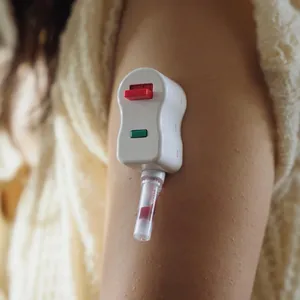
| SiPhox Longevity Essentials | $124 + $25 shipping ($99 first test advertised) | At home, upper-arm EasyDraw | 30 markers incl. ApoB, hs-CRP, HbA1c |
| SiPhox Ultimate 360 | $249 + $25 shipping | At home, several EasyDraw devices | 61 more markers |
| Your doctor | Depends on insurance | Venous draw | Usually needs to be requested |
For a test you may only need once, price per result matters more than the subscription. The Quest route is the cheapest if you are happy to visit a lab. SiPhox makes sense if you want to avoid a needle or a trip, or if you would rather get Lp(a) alongside ApoB and hs-CRP in the same draw. See our ApoB test guide for why the two belong together.
Prices seen 29 Sep 2026. Quest is $45 plus a $6 physician fee. SiPhox panel prices include $25 US shipping; shipping on the one-off kit was not shown. Our arithmetic: the $85 kit works out at $7.08 per marker for 12 markers.
Say Priya, 38, has a father who had a heart attack at 52. She orders the $85 SiPhox Kidney, Liver and Lp(a) kit and gets 160 nmol/L, in the high band. Because the level is inherited, the NLA advises testing first-degree relatives, so her mother and brother test once too: 3 x $85 = $255 for the three of them at home, or 3 x $51 = $153 at Quest if everyone can reach a lab.
Priya's Lp(a) will barely move, so she does not retest it. What she tracks instead is what she and her doctor can change: ApoB, LDL, blood pressure and blood sugar. Four SiPhox Longevity Essentials tests in a year cost $124 + 3 x $149 = $571 and report ApoB, LDL, hs-CRP and HbA1c each time, with her Lp(a) repeated for free on the same panel.
SiPhox kits that include Lp(a)
- Kidney, Liver and Lp(a) Panel, $85, one-off. Twelve markers: Lp(a), ALT, AST, AST:ALT ratio, albumin, total bilirubin, BUN, creatinine, BUN:creatinine ratio, eGFR, glucose and TIBC. No membership needed.
- Longevity Essentials, $124 per test. The default panel: Lp(a), ApoB, ApoA1, a full lipid panel, hs-CRP, HbA1c, hormones, vitamin D and ferritin.
- Heart & Metabolic, $124 per test. Lp(a) and ApoB with kidney and liver function.
- Ultimate 360, $249 per test. Everything, including Lp(a), in one larger kit.
Thyroid Focus, Hormone Focus and GLP Optimization do not include Lp(a). A smart way to use a SiPhox membership is to take Longevity Essentials or Heart & Metabolic once for your lifetime Lp(a) and ApoB baseline, then switch to other panels on later cycles. Our SiPhox review covers the membership rules, and the cost guide works out the yearly spend.
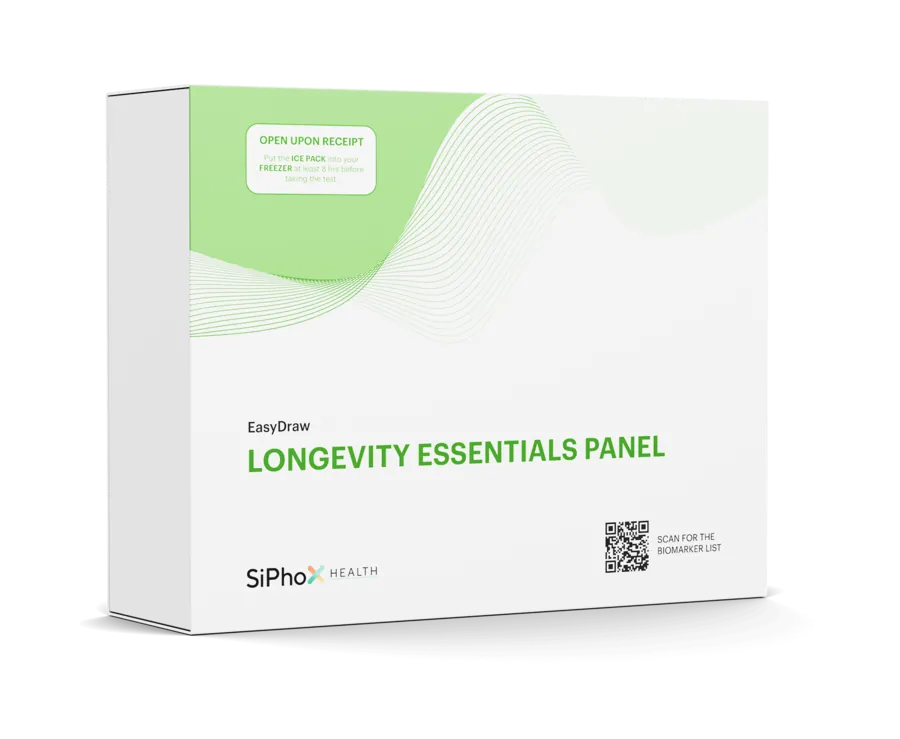
Longevity Essentials
The default panel: heart, metabolic, hormone and inflammation markers in one draw.
Check price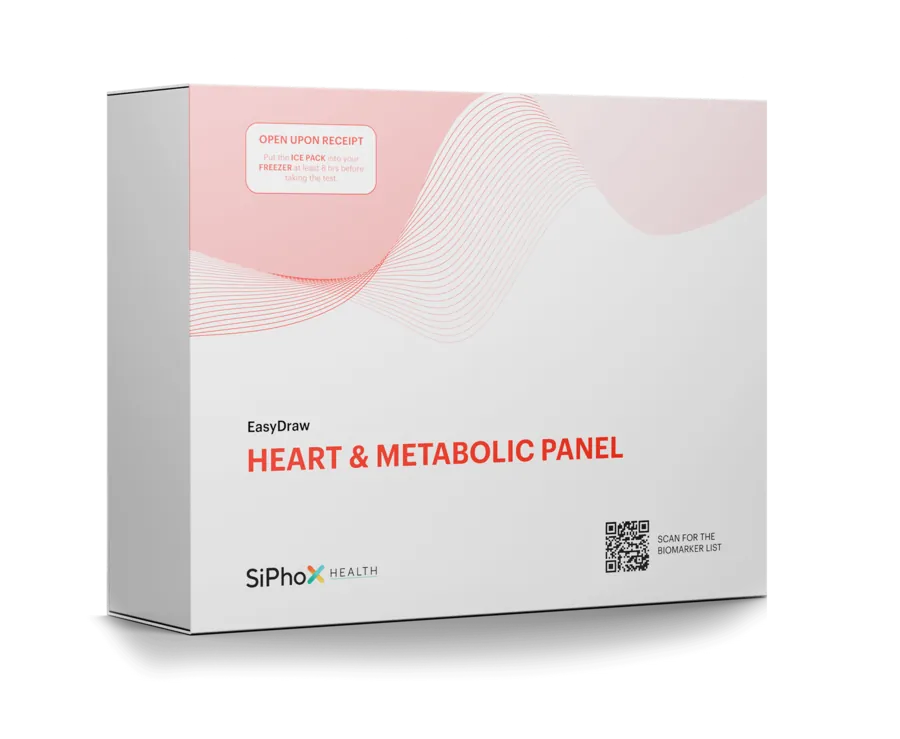
Heart & Metabolic
Lipids plus kidney and liver function: the panel for cardiovascular and metabolic risk.
Check price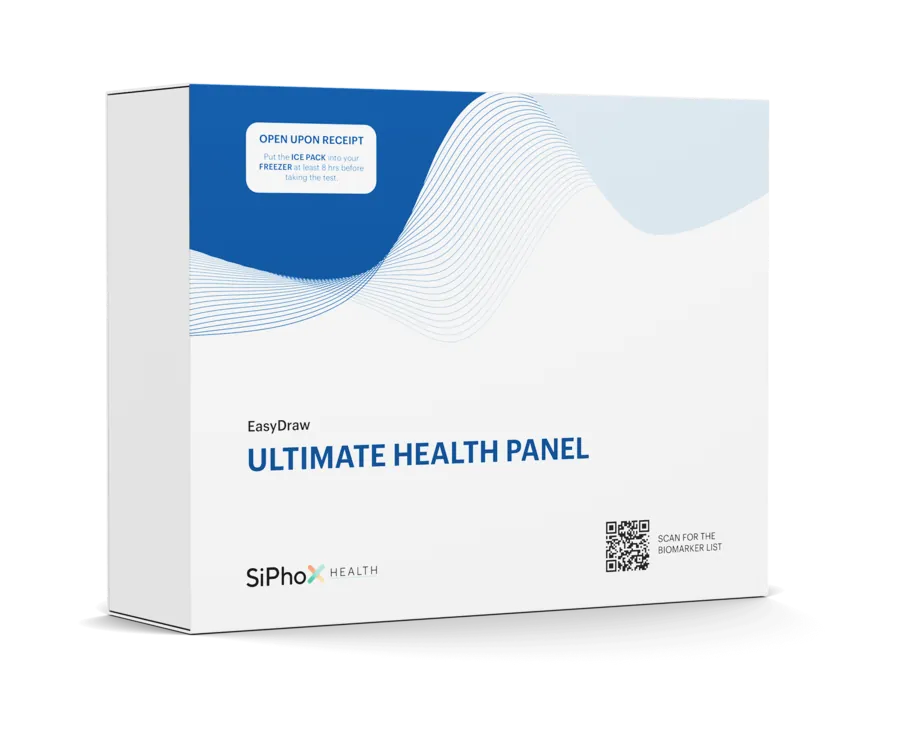
Ultimate 360
Everything on the four core panels plus iron studies, B12 and folate, GGT and PSA.
Check priceWhy Lp(a) and ApoB belong together
An Lp(a) particle is an LDL-like particle with an extra protein, apolipoprotein(a), attached to its ApoB. The American Heart Association's 2022 statement describes it as causal and largely genetic. Two practical points follow for anyone reading a home result:
- Every Lp(a) particle also counts as one ApoB particle. ApoB is a count of all the atherogenic particles, so a high Lp(a) pushes ApoB up a little too. Reading the two side by side tells you whether the problem is mostly inherited particles or mostly LDL you can lower.
- Standard LDL cholesterol includes the cholesterol inside Lp(a). Someone with very high Lp(a) can look as if their LDL is the whole story. That is one reason the NLA wants Lp(a) measured at least once.
| Marker | Changes with diet, exercise or statins? | How often it is worth testing |
|---|---|---|
| Lp(a) | Very little; 70% to 90%+ genetic | Once; repeat only if the first result is near a cut-off |
| ApoB | Yes | After each change in diet or medication |
| LDL cholesterol | Yes | After each change in diet or medication |
| hs-CRP | Yes, and with minor illness | Two readings two weeks apart for a risk estimate |
This is why a one-off Lp(a) kit and a repeatable panel are not really competitors. The one-off test answers a lifetime question; the panel tracks the numbers you can move. SiPhox's Longevity Essentials and Heart & Metabolic panels happen to do both in one draw.
Which Lp(a) route to choose
| If you | Best route | Why |
|---|---|---|
| Only want your lifetime number and can get to a lab | Quest Lp(a) | $51 all-in, the cheapest single result |
| Want it once, at home, with no membership | SiPhox Kidney, Liver and Lp(a) kit | $85, adds 11 kidney, liver and metabolic markers |
| Want Lp(a) as part of a baseline you will keep tracking | SiPhox Longevity Essentials | $124 first test with ApoB, hs-CRP and HbA1c |
| Also want kidney and liver function | SiPhox Heart & Metabolic | $149, Lp(a) and ApoB with eGFR, ALT and AST |
| Want everything in one draw once a year | SiPhox Ultimate 360 | $274 for 62 markers |
| Already have a result of 125 nmol/L or more | Your doctor or a lipid specialist | Treatment focuses on LDL, ApoB and other risks |
If your Lp(a) is high
There is no approved drug that targets Lp(a) specifically yet; several are in trials. The NLA advice for people with a high level is earlier and more intensive management of everything else: LDL cholesterol and ApoB, blood pressure, blood sugar and smoking, with lipid-lowering medication for those at high overall risk. It also recommends testing first-degree relatives. Lifestyle changes do little to Lp(a) itself, which is why retesting it every few months is not useful; retesting ApoB, LDL and HbA1c is.
A high Lp(a) is a reason to talk to your doctor or a lipid specialist, not a diagnosis. Take the printed result with its units.
Frequently asked questions
How much does an Lp(a) test cost?
About $45 plus a $6 physician fee at Quest (seen September 29, 2026), $85 for SiPhox's one-off Kidney, Liver and Lp(a) home kit, or $124 plus $25 shipping inside a SiPhox Longevity Essentials or Heart & Metabolic panel.
Who should get an Lp(a) test?
Every adult, at least once, according to the 2024 National Lipid Association update and the 2022 European Atherosclerosis Society statement. It is most urgent if a close relative had early heart disease or you have familial hypercholesterolemia.
Can I test Lp(a) at home?
Yes. SiPhox Health measures Lp(a) from an at-home kit, either in its $85 one-off panel or in its Longevity Essentials, Heart & Metabolic and Ultimate 360 panels, which use a needle-free upper-arm device.
How often should Lp(a) be tested?
Usually once. About 70% to 90% or more of the variation in Lp(a) is genetic, so it changes little over adult life. Some doctors repeat it once if the first result is close to a cut-off.
What is a high Lp(a) level?
125 nmol/L or more (roughly 50 mg/dL or more) is high risk; 75 to 124 nmol/L is intermediate; under 75 nmol/L is low, per the NLA 2024 update and Labcorp's report.
Sources
- Koschinsky ML et al. Focused update to the 2019 NLA scientific statement on Lp(a). J Clin Lipidol 2024
- Kronenberg F et al. Lp(a) in ASCVD and aortic stenosis: EAS consensus statement. Eur Heart J 2022
- Reyes-Soffer G et al. Lp(a): a genetically determined, causal and prevalent risk factor. AHA scientific statement 2022
- 2018 AHA/ACC Guideline on the Management of Blood Cholesterol. Circulation 2019
- Labcorp test 120188: Lipoprotein(a) (risk bands, interferences)
- Quest Health: Lipoprotein(a) test price
- SiPhox Health: Kidney, Liver and Lp(a) Panel
- SiPhox Health panel comparison (checked 29 Sep 2026)
- SiPhox Health: Longevity Essentials EasyDraw panel and price
- SiPhox Health: Heart & Metabolic EasyDraw panel
- SiPhox Health: Ultimate 360 EasyDraw panel