What a biological age test measures
Chronological age is how many birthdays you have had. Biological age is an estimate of how old your body behaves, built from measurements that change with age and predict disease and death. There are two main kinds of biological age test: epigenetic clocks, which read chemical tags (methylation) on your DNA from blood or saliva, and blood-marker scores, which combine routine lab results such as albumin, creatinine, glucose and CRP into an age-equivalent. Neither is a diagnosis, and no biological age score is used in clinical guidelines to decide treatment.

Epigenetic clocks vs blood-marker scores
| Type | Examples | Sample | Built to predict | Main limits |
|---|---|---|---|---|
| First-generation epigenetic clock | Horvath clock (2013) | DNA from blood or other tissue | Chronological age across tissues | Tracks age well but predicts health outcomes less well |
| Second-generation epigenetic clock | DNAm PhenoAge (2018), GrimAge (2019) | Blood DNA | Mortality and healthspan | Technical noise; cost; results differ between clocks |
| Pace-of-aging clock | DunedinPACE (2022) | Blood DNA | How fast you are aging now (years per calendar year) | Newer; built on one long-term cohort |
| Blood-marker score | Phenotypic Age (PhenoAge), commercial system-age models | Routine blood tests | Mortality risk expressed as an age | Moves with illness, hydration and lab variation |
Phenotypic Age, developed by Morgan Levine and colleagues, is the best-known blood-marker score. It combines chronological age with 9 routine markers: albumin, creatinine, glucose, C-reactive protein, lymphocyte percentage, mean cell volume (MCV), red cell distribution width (RDW), alkaline phosphatase and white cell count. The 2018 DNAm PhenoAge clock was then trained to predict that blood-based score from DNA methylation.
What the evidence shows
They predict risk at the population level. In 11,432 US adults from NHANES IV followed for about 12.6 years (1,012 deaths), Phenotypic Age was associated with all-cause mortality after adjusting for chronological age, including in people who reported no disease and had a normal BMI. GrimAge was named for how strongly it predicts lifespan and healthspan.
They are noisy for individuals. A 2022 Nature Aging study by Higgins-Chen and colleagues found technical noise produced deviations of up to 9 years between replicate samples for six prominent epigenetic clocks. Their principal-component versions brought most replicates within 1.5 years.
Source: Higgins-Chen et al., Nature Aging 2022, six epigenetic clocks tested on replicate samples.
What it means for you: a single result is a rough snapshot. A change of a few years between two tests may be noise rather than real aging or rejuvenation, and different companies' clocks can give different numbers for the same person. The most useful thing a biological age report does is point at the specific markers pulling the number up, which you can then look at directly.
The blood markers behind biological age
| Marker | Why it matters | What a result suggests | On SiPhox |
|---|---|---|---|
| Albumin | PhenoAge input; falls with illness and poor nutrition | Low albumin adds years in blood-based scores | Hormone Focus, Ultimate 360, GLP |
| Creatinine | PhenoAge input; kidney function | High creatinine adds years; muscle mass also raises it | Heart & Metabolic, Thyroid Focus, Ultimate 360, GLP |
| Glucose or HbA1c | PhenoAge uses glucose; many commercial models use HbA1c | Higher blood sugar adds years | Glucose: not on SiPhox. HbA1c: Longevity, Heart & Metabolic, Ultimate 360, GLP |
| CRP | PhenoAge input; inflammation | Higher CRP adds years; a cold can spike it | Longevity, Heart & Metabolic, Thyroid Focus, Ultimate 360, GLP |
| Alkaline phosphatase | PhenoAge input; liver and bone | Higher values add years | Heart & Metabolic, Ultimate 360, GLP |
| MCV, RDW, white cells, lymphocyte % | Four PhenoAge inputs from a blood count | Wider RDW and lower lymphocyte % add years | CBC add-on ($45) covers MCV, RDW and WBC; lymphocyte % not listed |
| ApoB and lipids | Used in many commercial cardiovascular ages | Higher ApoB raises cardiovascular age | Longevity, Heart & Metabolic, Ultimate 360, GLP |
| Cystatin C | Kidney marker less affected by muscle | Used in some kidney-age models | Not on SiPhox |
The takeaway: you cannot compute the published PhenoAge from any standard SiPhox panel, because glucose and lymphocyte percentage are not on them. SiPhox's own BioAge models use their own inputs, described below.
Worked example: two results six weeks apart
Illustrative numbers. A 50-year-old gets an epigenetic biological age of 46, then 52 on a second kit six weeks later with no change in habits. The 6-year swing is within the up-to-9-year replicate noise Higgins-Chen reported for original clocks, so it most likely says nothing about her health.
Compare a blood-marker route. Longevity Essentials with the Advanced BioAge Report costs $174 plus $25 shipping, $199 a test. Twice a year that is $398, and she also gets the 31 underlying markers: if her "cardiovascular age" is high, she can see that it is her ApoB and Lp(a) driving it, which is actionable in a way a single clock number is not. Our arithmetic from SiPhox prices checked 29 Sep 2026.
What an at-home test can and cannot do for biological age
- Turn a broad blood panel into an easy-to-follow age score and trend
- Point at the markers (blood sugar, lipids, inflammation) pulling the score up
- Motivate long-term habits you track over years
- Diagnose anything: a diagnosis needs a clinician
- Give a precise, stable number; repeat tests can differ by years
- Prove that a supplement or protocol slowed aging
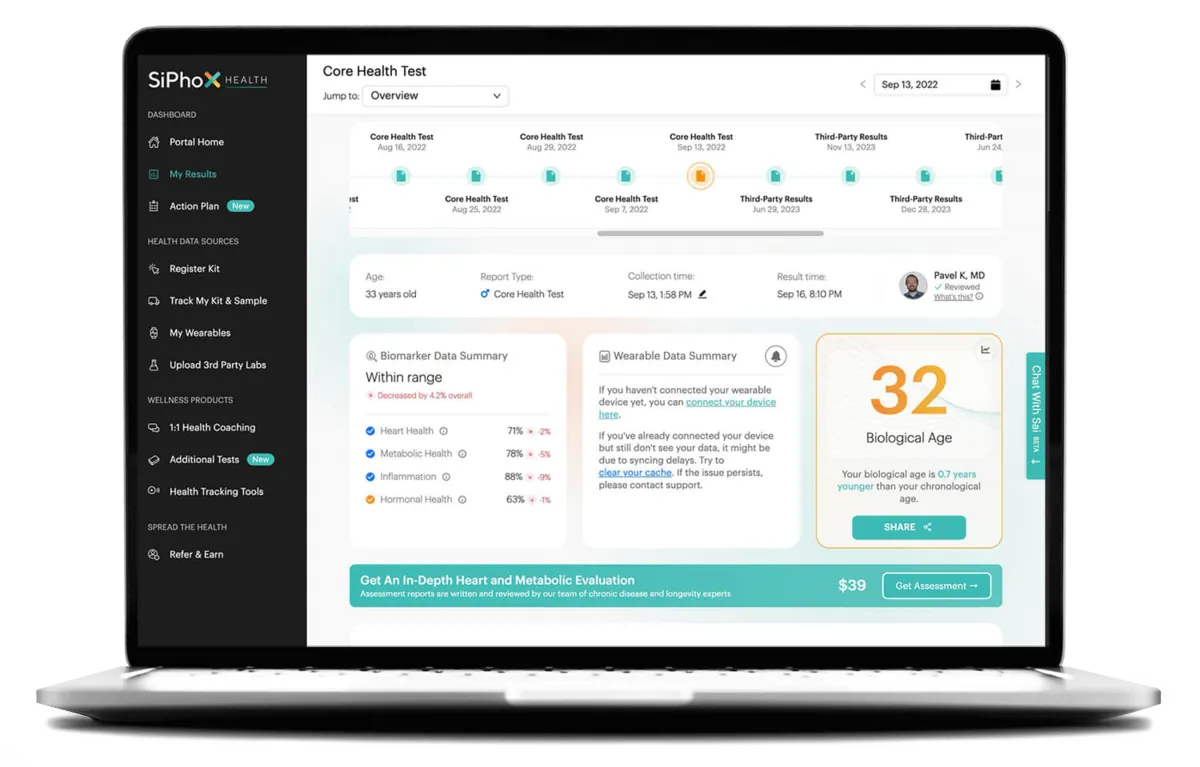
The SiPhox BioAge option
SiPhox sells an Advanced BioAge Report as a +$50 add-on per test on the Longevity Essentials and Heart & Metabolic panels, according to its checkout data on 29 Sep 2026. It gives an overall biological age plus system ages. SiPhox's pages disagree on the count: the checkout description says 9 system ages, while its hub guide (updated 27 Aug 2026) lists 10 (cardiovascular, metabolic, respiratory, brain, liver, kidney, bone, thyroid, blood and inflammation) plus the overall age.
- How it is built: SiPhox says the models come from VOLO Health, use gradient-boosting machines trained on long-term health outcomes from a cohort of roughly half a million people with linked medical records, and are calibrated on US clinical records.
- What SiPhox itself says: "This is a model, not a measurement", some systems are "inferred, not measured", and single results are snapshots affected by hydration, fasting and time of day. That matches the research above.
- A simpler Biological Age score is also described in SiPhox's hub, trained on chronological age rather than outcomes. We could not confirm on the pricing pages whether it is included with every membership.
| If you want | Test | Choose |
|---|---|---|
| A blood-based biological age with the markers behind it | Longevity Essentials + Advanced BioAge | Longevity Essentials + $50 |
| The same with kidney and liver markers | Heart & Metabolic + Advanced BioAge | Heart & Metabolic + $50 |
| The widest marker set to act on | 62 biomarkers | Ultimate 360 |
| A DNA methylation clock | Saliva or blood methylation kit | A specialist epigenetic test |
For the broader longevity panel question, see our longevity blood test guide.

Longevity Essentials
The default panel: heart, metabolic, hormone and inflammation markers in one draw.
Check price
Heart & Metabolic
Lipids plus kidney and liver function: the panel for cardiovascular and metabolic risk.
Check price
Ultimate 360
Everything on the four core panels plus iron studies, B12 and folate, GGT and PSA.
Check price
Frequently asked questions
How accurate are biological age tests?
They predict mortality in large groups, but individual results are noisy. A 2022 study found technical noise alone produced differences of up to 9 years between repeat samples on six epigenetic clocks.
What blood tests are used to calculate biological age?
The best-known formula, PhenoAge, uses albumin, creatinine, glucose, CRP, lymphocyte percentage, MCV, RDW, alkaline phosphatase and white cell count, plus chronological age. Commercial models often add HbA1c and lipids.
Is a DNA methylation test better than a blood test for biological age?
Not clearly. Newer clocks such as GrimAge and DunedinPACE predict outcomes well in research, but they cost more and can be noisy. Blood-marker scores come with numbers you can act on directly.
Can you lower your biological age?
Blood-based scores move when the underlying markers move, for example when blood sugar, inflammation or cholesterol improve. Whether that means slower aging is not proven.
How much does the SiPhox BioAge report cost?
The Advanced BioAge Report is a +$50 add-on per test on Longevity Essentials or Heart & Metabolic, so $174 plus $25 shipping on the standard membership price.
Sources
- Liu Z et al. A new aging measure captures morbidity and mortality risk across diverse subpopulations from NHANES IV. PLoS Med 2018
- Levine ME et al. An epigenetic biomarker of aging for lifespan and healthspan (DNAm PhenoAge). Aging 2018
- Horvath S. DNA methylation age of human tissues and cell types. Genome Biol 2013
- Lu AT et al. DNA methylation GrimAge strongly predicts lifespan and healthspan. Aging 2019
- Belsky DW et al. DunedinPACE, a DNA methylation biomarker of the pace of aging. eLife 2022
- Higgins-Chen AT et al. A computational solution for bolstering reliability of epigenetic clocks. Nat Aging 2022
- SiPhox Health hub: Biological Age vs Advanced Biological Age (updated 27 Aug 2026)
- SiPhox Health hub: how the Advanced BioAge is calculated (updated 27 Aug 2026)
- SiPhox Health: Longevity Essentials panel and add-ons (checked 29 Sep 2026)
- SiPhox Health: Heart & Metabolic panel (checked 29 Sep 2026)
- SiPhox Health: membership, panels and pricing (checked 29 Sep 2026)