What is creatinine?
Creatinine is a waste product of the normal wear and tear on your muscles. Healthy kidneys filter it out of the blood and into the urine, and in a healthy person the level stays fairly stable over time. If the kidneys filter less, creatinine builds up in the blood.
That makes blood creatinine a simple kidney check, and it is the main input to eGFR, the estimate of how much your kidneys filter per minute. It has one big weakness: how much creatinine you make depends on how much muscle you have, what you eat and how active you are, so "normal" differs from person to person.
Creatinine normal range
| Group | mg/dL | µmol/L |
|---|---|---|
| Men | 0.7 to 1.3 | 62 to 115 |
| Women | 0.5 to 0.95 | 44 to 84 |
Source: MedlinePlus. To convert mg/dL to µmol/L, multiply by 88.4. Women usually run lower than men because they tend to have less muscle mass. Other labs publish slightly different limits, so always read your result against the range printed on your own report.
MedlinePlus. Your lab's limits may differ slightly, and muscle mass shifts where you sit.
A normal creatinine does not guarantee healthy kidneys. MedlinePlus points out that creatinine can stay in the normal range in early kidney disease and only rise as the condition gets more serious, which is why doctors look at eGFR and urine albumin as well.
Reading creatinine with eGFR and BUN
Lab reports usually print creatinine next to eGFR and BUN (blood urea nitrogen, another waste product the kidneys clear). Creatinine is the measured value; eGFR turns it into a filtering estimate that accounts for age and sex. The same creatinine of 1.2 mg/dL works out to an eGFR of about 83 for a 30-year-old man but about 47 for a 75-year-old woman on the 2021 CKD-EPI equation, which is why you should not judge creatinine on its own.
Your doctor may also order urine tests: a urine creatinine, a creatinine clearance that compares blood and urine levels, or a urine albumin to creatinine ratio, which picks up small amounts of protein leaking into the urine, one of the earliest signs of kidney damage.

What high creatinine means
MedlinePlus lists these causes of a higher-than-normal creatinine:
- Kidney problems, such as kidney damage or failure, infection or reduced blood flow to the kidneys
- A blocked urinary tract
- Dehydration
- Muscle breakdown (rhabdomyolysis) and other muscle disorders or injuries
- Conditions that affect the kidneys, such as heart failure or diabetes
- Pregnancy complications such as preeclampsia
High creatinine does not always mean a kidney problem. MedlinePlus notes it can also follow intense exercise or a diet high in meat. A single high result usually leads to a repeat test and other kidney tests rather than a diagnosis. If yours is above the range, or rising between tests, talk to your doctor.
Worked example: a creatinine of 1.4 in a weightlifter
Say a 35-year-old man who lifts weights five days a week gets a creatinine of 1.4 mg/dL, just above MedlinePlus's 0.7 to 1.3 range for men, and his report shows a lower eGFR as a result. The draw came the morning after a heavy leg session and a steak dinner.
Three things on this page could explain it without kidney disease: more muscle makes more creatinine, meat can raise it for a short time, and hard exercise can push it up. A fair retest means 24 hours without meat, no hard workout the day before and normal hydration.
If the repeat is still high, questions for the doctor: Should we check a urine albumin to creatinine ratio? Would a cystatin C test give a truer eGFR for my build? Could any of my medicines or supplements be affecting it?
What low creatinine means
Low creatinine is uncommon and is usually about muscle rather than kidneys. MedlinePlus links it to low muscle mass (from long illness, nerve and muscle conditions or muscle loss with age), malnutrition and, less often, serious liver disease. A slightly low value in a slim, less muscular person is often normal for them.
What can change your creatinine
- Muscle mass. More muscle means more creatinine. A strength-trained person can sit above the range with normal kidneys.
- Meat. Meat can temporarily raise creatinine, so some providers ask you to avoid it for 24 hours before the test.
- Hard exercise and dehydration. Both can push creatinine up for a short time.
- Medicines. Cimetidine, famotidine and some antibiotics (such as trimethoprim and cefoxitin) can affect the result. Do not stop a medicine without asking your doctor.
- Kidney health over time. Blood pressure and blood sugar control (see HbA1c) are what protect the kidneys long term. Any treatment is a decision for your doctor.
How to test creatinine
- Avoid a large meat meal and hard exercise the day before, and be normally hydrated.
- Fasting is not needed for creatinine alone, but a basic or comprehensive metabolic panel may ask for up to 12 hours.
- List every medicine and supplement for whoever orders the test.
- Track the trend at the same lab. A steady creatinine over years says more than one reading.
Common questions about creatinine
How often should creatinine be checked?
There is no fixed schedule for healthy adults. The NKF says anyone with a CKD risk factor (diabetes, high blood pressure, overweight, age over 60 or a family history of kidney disease) should ask for an eGFR test, and that a low result should be repeated in 3 months. Because eGFR is calculated from creatinine, that means a creatinine test each time.
What should be tested with creatinine?
eGFR, BUN and the BUN to creatinine ratio are usually printed together. The NKF also recommends a urine albumin test for a complete picture of kidney health. For people whose muscle mass is far from average, cystatin C gives a second filtration estimate that does not depend on muscle. Our kidney function test guide explains the full set.
How fast can creatinine change?
Meat and hard exercise raise it for a short time, which is why some providers ask you to skip meat for 24 hours before the test. Dehydration raises it too, and the reading can return to your usual level once you rehydrate. A rise that persists on repeat tests at the same lab is the pattern worth acting on.
Which at-home tests include creatinine
SiPhox Health measures creatinine on the same four panels that report eGFR:
| SiPhox panel | Kidney markers | Price per test |
|---|---|---|
| Heart & Metabolic | Creatinine, eGFR, BUN, BUN:creatinine ratio | $124 + $25 shipping |
| Thyroid Focus | Creatinine, eGFR | $124 + $25 shipping |
| Ultimate 360 | Creatinine, eGFR, BUN, BUN:creatinine ratio | $249 + $25 shipping |
| GLP Optimization | Creatinine, eGFR, BUN, BUN:creatinine ratio | $199 + $25 shipping |
Longevity Essentials and Hormone Focus do not include creatinine. For most people, Heart & Metabolic is the obvious pick: it pairs kidney markers with lipids, ApoB, HbA1c and liver enzymes, and it is included in the base membership. See our SiPhox review for how the upper-arm draw and lab compare with a clinic test.

Heart & Metabolic
Lipids plus kidney and liver function: the panel for cardiovascular and metabolic risk.
Check price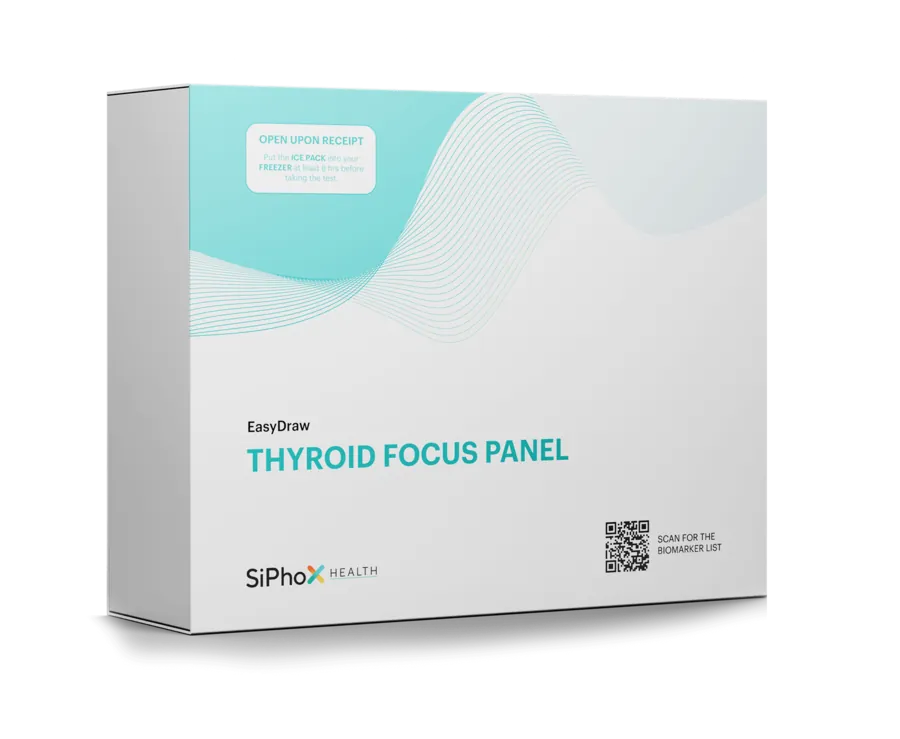
Thyroid Focus
A full thyroid workup including both thyroid antibodies, plus core lipids.
Check price
Ultimate 360
Everything on the four core panels plus iron studies, B12 and folate, GGT and PSA.
Check priceFrequently asked questions
What is a normal creatinine level?
About 0.7 to 1.3 mg/dL for men and 0.5 to 0.95 mg/dL for women (MedlinePlus). In µmol/L that is 62 to 115 and 44 to 84. Your lab may use slightly different limits.
What level of creatinine is dangerous?
There is no single cut-off because creatinine depends on muscle mass. Doctors judge it through eGFR: below 60 for three months suggests chronic kidney disease and below 15 suggests kidney failure. Any result above your lab range, or a clear rise between tests, is worth taking to your doctor.
Can exercise raise creatinine?
Yes. Intense exercise can raise blood creatinine for a short time, as can a diet high in meat. Avoid hard workouts and large meat meals the day before a test.
Is creatinine the same as eGFR?
No. Creatinine is measured in your blood; eGFR is calculated from it, together with age and sex. When creatinine goes up, eGFR goes down.
Sources
- MedlinePlus Medical Encyclopedia: Creatinine blood test
- MedlinePlus Lab Tests: Creatinine test
- MedlinePlus Lab Tests: Glomerular filtration rate (GFR) test
- National Kidney Foundation: Estimated glomerular filtration rate (eGFR)
- MedlinePlus Medical Encyclopedia: Glomerular filtration rate
- SiPhox Health: panel comparison (checked 29 Sep 2026)
- SiPhox Health: Heart & Metabolic panel
- SiPhox Health: Thyroid Focus panel