Which blood tests for hair loss to ask for
The American Academy of Dermatology says a dermatologist orders a blood test when hair loss could come from a disease, a vitamin deficiency, a hormone imbalance or an infection. Cleveland Clinic lists what that blood test usually covers: vitamin and mineral levels such as vitamin D, B vitamins, zinc and iron, and hormones such as thyroid. For women with acne, irregular periods or excess facial hair, androgens are added.
| Marker | Why it matters | What a result suggests | On SiPhox |
|---|---|---|---|
| Ferritin | The most studied nutrient link to shedding in women | Low ferritin means low iron stores; ferritin rises with inflammation, so read it with CRP | Longevity, Thyroid Focus, Ultimate 360, GLP |
| Iron, TIBC, saturation | Confirms iron deficiency | Low saturation with low ferritin fits iron deficiency | Ultimate 360, GLP |
| Hemoglobin | Anemia can accompany diffuse shedding | Under 12.0 g/dL in women or 13.0 g/dL in men meets the WHO anemia cut-off | Longevity, Heart & Metabolic, Ultimate 360, GLP |
| TSH | Both under- and overactive thyroid cause diffuse thinning | High TSH suggests hypothyroidism, very low TSH suggests hyperthyroidism | Longevity, Heart & Metabolic, Thyroid Focus, Ultimate 360, GLP |
| Free T4 and TPO antibodies | Confirm a thyroid problem and its autoimmune cause | Positive TPO antibodies point to Hashimoto's disease | Thyroid Focus, Ultimate 360 |
| Vitamin D | Low levels are reported more often in alopecia areata and shedding | Under 12 ng/mL risks deficiency; 20 ng/mL is enough for most people | Longevity, Ultimate 360, GLP |
| B12 and folate | Needed for rapidly dividing cells such as hair follicles | Low values need a cause, such as diet or absorption | Ultimate 360, GLP |
| Zinc | Deficiency is linked to shedding | Low zinc is uncommon without a diet or gut problem | Not on SiPhox |
| Total and free testosterone | High androgens drive female-pattern thinning in PCOS | High in a woman suggests an androgen excess worth a doctor's workup | Longevity (men), Hormone Focus, Ultimate 360, GLP (men) |
| DHEA-S | An adrenal androgen | Very high values need prompt medical review | Longevity, Hormone Focus, Ultimate 360 |
| Prolactin | High prolactin can cause irregular periods and thinning | Raised values are repeated before anything else is done | Hormone Focus, Ultimate 360 |
| SHBG | Sets how much testosterone is free | Low SHBG raises free testosterone even when total looks normal | Longevity (men), Thyroid Focus, Hormone Focus, Ultimate 360, GLP |
Male pattern hair loss, the receding hairline and crown thinning that most men eventually get, is diagnosed by its pattern, and blood tests are mainly used when shedding is sudden, diffuse or comes with other symptoms. There is no routine blood test for DHT in hair loss, and no blood test diagnoses alopecia areata.
Which types of hair loss blood tests can explain
| Type | What it looks like | Blood tests help? |
|---|---|---|
| Telogen effluvium | Diffuse shedding, often a few months after illness, surgery, childbirth, crash dieting or stress | Yes: ferritin, hemoglobin, thyroid and vitamin D look for a lasting trigger |
| Female-pattern hair loss | Widening part and thinning on top | Sometimes: androgens if there are acne or cycle changes; iron and thyroid to rule out add-on causes |
| Male-pattern hair loss | Receding temples and crown | Rarely: diagnosed by pattern |
| Alopecia areata | Round, smooth bald patches | For linked conditions only, such as thyroid disease |
| Scarring alopecia | Patches with redness or scaling | No: needs a dermatologist and often a scalp biopsy |
The timing clue matters. Cleveland Clinic explains that the resting (telogen) phase lasts about two to four months, which is why shedding often shows up well after the event that caused it. A result that is normal today does not rule out a trigger three months ago.
How strong is the iron link? A review from the Cleveland Clinic dermatology department (Trost 2006) concluded there was not enough evidence to screen everyone with hair loss for iron deficiency, but its authors still screen their own patients because treating iron deficiency seemed to help. A 2019 review of vitamins and minerals in hair loss reached a similar place: deficiencies may be a modifiable risk factor, and better trials are needed. So testing is reasonable; expecting a supplement to regrow hair on its own is not.
Hair-loss markers by SiPhox panel
Our count from SiPhox's published panel lists (checked 29 Sep 2026) against 12 hair-loss markers: ferritin, iron, hemoglobin, TSH, free T4, TPO antibodies, vitamin D, B12, folate, testosterone, DHEA-S and prolactin. Zinc is on no SiPhox panel. Testosterone on Longevity and GLP is reported for men only.
Ultimate 360 is the only panel that covers all 12; zinc is missing from every panel. GLP Optimization covers 9 but no thyroid antibodies, DHEA-S or prolactin. Longevity Essentials covers the iron-and-thyroid basics without B12, folate or the thyroid antibodies, and Thyroid Focus pairs the full thyroid set with ferritin.
Worked example: shedding after a crash diet
Illustrative numbers. A 29-year-old woman lost 25 lb in four months on a very low calorie diet. Three months later her hair is coming out in handfuls. She orders an at-home panel:
| Marker | Result | Reading |
|---|---|---|
| Ferritin | 14 ng/mL | Low iron stores (well under the 45 ng/mL cut-off the AGA uses for iron deficiency in anemia) |
| Hemoglobin | 12.6 g/dL | Not anemic by the WHO 12.0 g/dL cut-off |
| TSH | 1.8 mIU/L | Normal |
| Vitamin D | 18 ng/mL | Below the 20 ng/mL National Academies threshold |
| Total testosterone and DHEA-S | Within the lab range | No sign of androgen excess |
The story and timing fit telogen effluvium after rapid weight loss, with low iron stores and low vitamin D as correctable extras. She takes the results to her doctor or a dermatologist, who confirms the pattern, looks for why ferritin is low and advises on replacement. A repeat ferritin and vitamin D in about three months shows whether levels have recovered; regrowth usually lags behind.
What an at-home test can and cannot do for hair loss
- Screen iron, thyroid, vitamin D, B12 and androgens without a lab visit
- Recheck ferritin and vitamin D while you replace them
- Give a dermatologist a head start at the first appointment
- Tell which type of hair loss you have: a diagnosis needs a clinician, often with a scalp exam
- Test zinc, or rule out infection or scarring causes
- Predict whether a supplement will regrow hair
Biotin is sold as a hair supplement, and the FDA warns that high doses can interfere with lab tests, including thyroid and hormone tests. Tell whoever reads your results if you take it, and ask whether to pause it before testing.
Best-fit SiPhox panel for hair loss
| If you want | Test | Choose |
|---|---|---|
| The fullest hair-loss screen | Ferritin, iron studies, hemoglobin, full thyroid, vitamin D, B12, folate, androgens | Ultimate 360 |
| Iron and thyroid basics | Ferritin, hemoglobin, TSH, vitamin D, DHEA-S | Longevity Essentials |
| A thyroid-first check | TSH, free T4, free T3, both antibodies, ferritin | Thyroid Focus |
| Acne, irregular periods or facial hair | Testosterone, free testosterone, SHBG, DHEA-S, prolactin, LH, FSH | Hormone Focus |
| Zinc or a scalp biopsy | Venous lab or dermatology visit | Your doctor |
Ultimate 360 costs $249 plus $25 shipping. The core panels cost $124 plus shipping and you can switch panel every time you test, so a common plan is Ultimate 360 first, then Longevity Essentials to recheck ferritin and vitamin D. Women whose thinning comes with cycle changes should also read our PCOS blood test guide, and anyone with thyroid symptoms our hypothyroidism blood test guide.
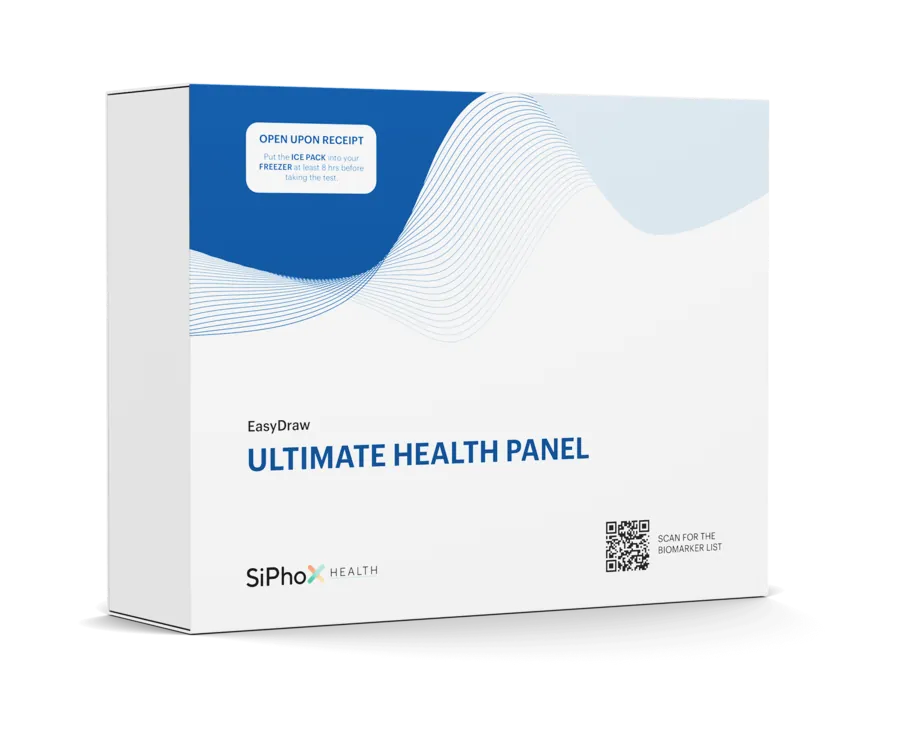
Ultimate 360
Everything on the four core panels plus iron studies, B12 and folate, GGT and PSA.
Check price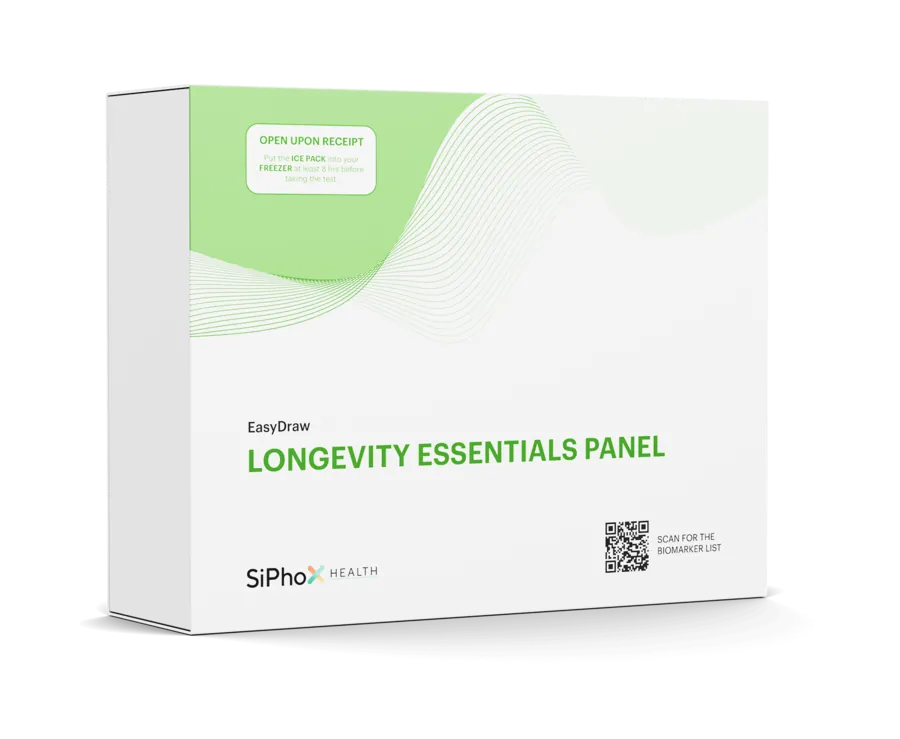
Longevity Essentials
The default panel: heart, metabolic, hormone and inflammation markers in one draw.
Check price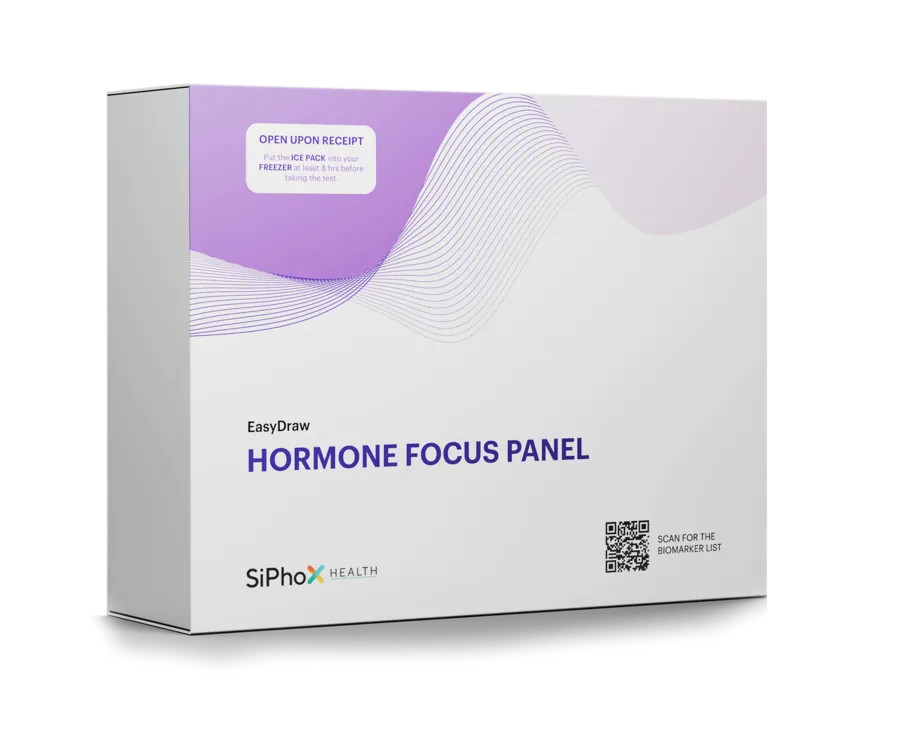
Hormone Focus
Sex hormones for men and women, including PSA for men and progesterone for women.
Check price
Frequently asked questions
What blood tests should I get for hair loss?
Ferritin and iron studies, hemoglobin, TSH (with free T4 if TSH is abnormal), vitamin D, B12 and folate. Women with acne, irregular periods or facial hair should add total and free testosterone, DHEA-S and prolactin.
What ferritin level causes hair loss?
There is no agreed cut-off for hair loss. The AGA uses 45 ng/mL to diagnose iron deficiency in people with anemia, and reviews note that evidence linking low ferritin to hair loss is mixed. Your doctor decides whether to treat.
Can thyroid problems cause hair loss?
Yes. Both hypothyroidism and hyperthyroidism can cause diffuse thinning. TSH is the first test; free T4 and thyroid antibodies confirm the problem and its cause.
Do men need a blood test for hair loss?
Usually not for typical male-pattern hair loss, which is diagnosed by its pattern. A blood test makes sense if shedding is sudden or diffuse, or comes with fatigue, weight change or other symptoms.
Can a home blood test diagnose hair loss?
No. It can show low iron, thyroid problems or low vitamin levels, but the type of hair loss is diagnosed by a clinician, often with a scalp exam and sometimes a biopsy.
Sources
- American Academy of Dermatology: Hair loss, diagnosis and treatment
- Cleveland Clinic: Hair loss in women
- Trost LB et al. The diagnosis and treatment of iron deficiency and its potential relationship to hair loss. J Am Acad Dermatol 2006
- Almohanna HM et al. The role of vitamins and minerals in hair loss: a review. Dermatol Ther 2019
- Ko CW et al. AGA clinical practice guidelines on the gastrointestinal evaluation of iron deficiency anemia. Gastroenterology 2020
- WHO: Guideline on haemoglobin cutoffs to define anaemia in individuals and populations (2024)
- Ross AC et al. The 2011 report on dietary reference intakes for calcium and vitamin D from the Institute of Medicine. J Clin Endocrinol Metab 2011
- MedlinePlus: Ferritin blood test
- MedlinePlus: Iron tests
- MedlinePlus: TSH (thyroid-stimulating hormone) test
- MedlinePlus: Thyroid antibodies test
- MedlinePlus: Testosterone levels test
- FDA: Biotin interference with lab tests
- SiPhox Health: Ultimate 360 panel (checked 29 Sep 2026)
- SiPhox Health: Longevity Essentials panel and add-ons (checked 29 Sep 2026)
- SiPhox Health: Thyroid Focus panel (checked 29 Sep 2026)
- SiPhox Health: Hormone Focus panel (checked 29 Sep 2026)