Quick answer: for B12 levels, MedlinePlus lists a normal result of 299 to 1,054 pg/mL (219 to 773 pmol/L) and says under 299 pg/mL is a possible sign of deficiency. The NIH Office of Dietary Supplements says levels under 200 or 250 pg/mL are generally considered subnormal, and that when B12 is between 150 and 399 pg/mL, a methylmalonic acid (MMA) test can confirm a deficiency. Ranges differ between labs, so use your own report.

B12 levels: normal range
| B12 (pg/mL) | pmol/L | Meaning | Source |
|---|---|---|---|
| 299 to 1,054 | 219 to 773 | Normal range | MedlinePlus |
| Under 299 | Under 219 | Possible deficiency | MedlinePlus |
| Under 200 to 250 | Under about 148 to 185 | Generally considered subnormal | NIH ODS |
| 150 to 399 | About 111 to 295 | MMA test can confirm deficiency | NIH ODS |
To convert pg/mL to pmol/L, multiply by about 0.74. The NIH adds that an MMA above 0.271 micromol/L suggests B12 deficiency, though MMA also rises with kidney problems and tends to be higher in older adults.
MedlinePlus and the NIH Office of Dietary Supplements. Multiply pg/mL by about 0.74 for pmol/L.
What is vitamin B12?
Vitamin B12 is needed to make red blood cells and DNA and to keep nerves working. It comes almost entirely from animal foods and fortified foods or supplements. To absorb it, your stomach needs acid and a protein called intrinsic factor, which is why stomach conditions and some medicines cause deficiency even with a good diet.
A blood B12 level is an imperfect measure: a result in the low-normal range does not rule out deficiency. That is why the MMA test exists, and why folate is usually checked at the same time, since both deficiencies cause the same type of anemia.
What low B12 means
Low B12 can cause anemia and, if it goes on, nerve damage. Cleveland Clinic lists symptoms such as tiredness, pale skin, numbness or tingling in the hands and feet, memory problems and mood changes. Causes and risk factors from MedlinePlus and Cleveland Clinic:
- Diet: vegan or vegetarian eating without fortified foods or supplements
- Absorption: pernicious anemia (no intrinsic factor), gastritis, Crohn's disease, celiac disease and stomach or bowel surgery
- Medicines: metformin, proton pump inhibitors, H2 blockers and oral birth control pills
- Age: Cleveland Clinic lists age over 75 as a risk factor
- Other: chronic alcohol use, Sjogren's syndrome, pregnancy and an overactive thyroid
If you take metformin long term, ask your doctor how often B12 should be checked.
How to read your B12 result
- Compare it with your lab's range, and with MedlinePlus, which treats under 299 pg/mL as a possible sign of deficiency.
- If it is between 150 and 399 pg/mL, ask about an MMA test. The NIH says an MMA above 0.271 micromol/L suggests deficiency, but kidney problems and older age also raise MMA.
- Look at folate and a blood count at the same time, since both deficiencies cause the same type of anemia.
- Note any supplements, which can make a result harder to interpret.
Worked example: B12 of 265 on metformin
Say a 62-year-old man who has taken metformin for eight years gets a B12 of 265 pg/mL (about 196 pmol/L) and has noticed tingling in his feet. 265 is 34 pg/mL under the MedlinePlus normal floor of 299, just above the NIH's 200 to 250 pg/mL subnormal zone, and inside the 150 to 399 pg/mL range where an MMA test can settle the question.
What might explain it: metformin is on the MedlinePlus and Cleveland Clinic list of medicines linked to low B12, and numbness or tingling in the hands and feet is one of the symptoms Cleveland Clinic lists. Tingling has other causes too, which is why confirmation matters before treatment.
Questions to take to his doctor:
- Should I have an MMA test? The NIH says above 0.271 micromol/L suggests deficiency.
- Is my kidney function normal (eGFR)? Kidney problems raise MMA too.
- Should we check folate and a blood count at the same time?
- If I am low, which form of B12 should I take, and how often should B12 be checked while I stay on metformin?
What high B12 means
MedlinePlus says a raised B12 is uncommon, since excess is usually removed in the urine. The most common reason is supplements or injections. Cleveland Clinic and MedlinePlus also list liver disease (cirrhosis or hepatitis), kidney failure and some blood cancers, such as myeloproliferative disorders. A very high result without supplements is worth raising with your doctor.
What moves B12 levels
- Food: meat, fish, eggs and dairy, or fortified foods for vegans.
- Supplements and injections: both raise levels. If absorption is the problem, your doctor will choose the form and dose.
- Medicines: metformin and acid-reducing drugs lower absorption over time. Do not stop them without advice.
- Tell the lab: list any B12 supplements or injections, since they change how a result should be read.
How to test B12
MedlinePlus says not to eat or drink for about 6 to 8 hours before the test and to tell your provider about all medicines, since several can interfere. If the result is borderline, the usual next steps are MMA and sometimes homocysteine (Cleveland Clinic), plus a blood count. Test B12 and folate together if anemia is the question.
Which at-home tests include B12
Vitamin B12 is on two SiPhox panels: Ultimate 360 and GLP Optimization. Longevity Essentials, Heart & Metabolic, Thyroid Focus and Hormone Focus do not include it.
| SiPhox panel | Biomarkers per test | Per test, with shipping | Listed as |
|---|---|---|---|
| Ultimate 360 | 62 | $274 | Vitamin B12 (Nutrition) |
| GLP Optimization | 46 | $224 | Vitamin B12 (Nutrition) |
Both panels also include folate, ferritin, iron, TIBC and iron saturation, so you get the main nutritional causes of anemia in one draw. SiPhox does not offer MMA on these panels, so a borderline B12 still needs a follow-up test through your doctor. The GLP panel is aimed at people on GLP-1 medicines; see our GLP-1 blood test page, the ferritin page and our SiPhox review.

Ultimate 360
Everything on the four core panels plus iron studies, B12 and folate, GGT and PSA.
Check price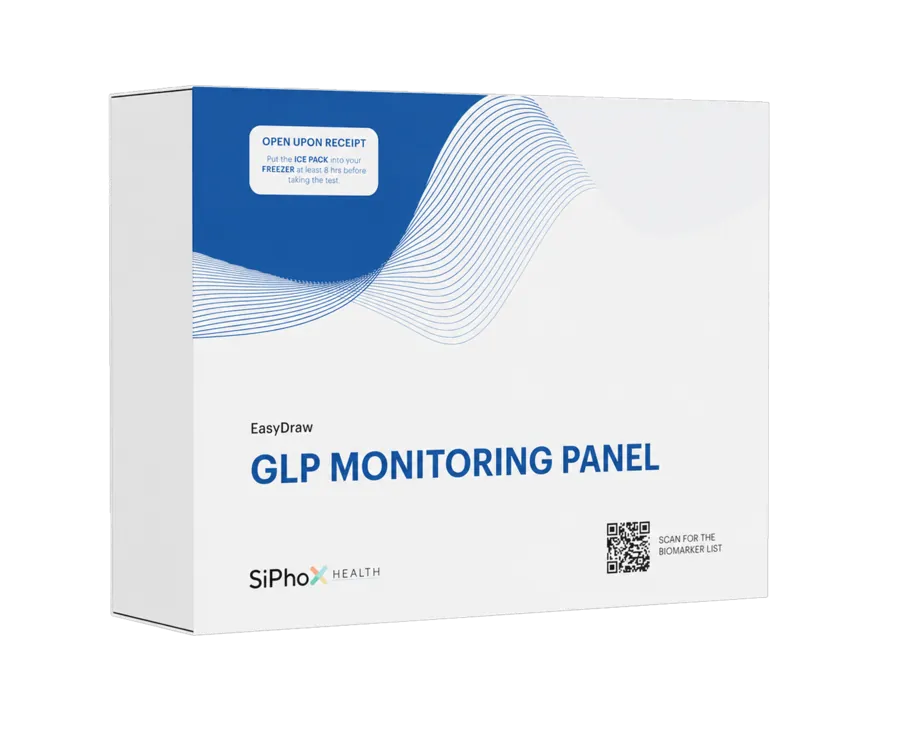
GLP Optimization
Built for people on GLP-1 medication: metabolic, liver, kidney, nutrient and iron markers.
Check price
Frequently asked questions
What is a normal B12 level?
MedlinePlus gives 299 to 1,054 pg/mL (219 to 773 pmol/L). The NIH says levels under 200 to 250 pg/mL are generally considered low.
Is a B12 of 300 low?
It is at the bottom of the MedlinePlus normal range and inside the 150 to 399 pg/mL zone where the NIH says an MMA test can confirm whether you are deficient.
What causes low B12?
Common causes are vegan diets without supplements, pernicious anemia, gut conditions such as Crohn's or celiac disease, stomach surgery, and long-term metformin or acid-reducing medicines.
Is high B12 dangerous?
Usually it reflects supplements. Without supplements, a high level can be linked to liver disease, kidney failure or some blood disorders, so mention it to your doctor.
Do I need to fast for a B12 test?
MedlinePlus says not to eat or drink for about 6 to 8 hours before the test.