What is progesterone?
Progesterone is a hormone made mainly by the ovaries. Each month it prepares the uterus for pregnancy. In the first half of the cycle, estradiol thickens the uterine lining; after an ovary releases an egg, progesterone rises and gets the lining ready for a fertilized egg to implant. If you do not become pregnant, progesterone falls and your period starts. If you do, it keeps rising to support the pregnancy.
In pregnancy, high progesterone helps a fertilized egg attach to the uterine lining, stops the immune system from attacking it, keeps the uterus from contracting too early and plays a role in developing the placenta. That is why it is sometimes checked in early pregnancy.
That timing is the whole story of a progesterone test. MedlinePlus says levels start to rise midway through the cycle, keep rising for about 6 to 10 days, then fall if the egg is not fertilized. A result only means something next to the day of your cycle it was drawn on, which is why one of its main uses is to check whether ovulation happened.
Progesterone levels by cycle day
| Group | ng/mL | nmol/L |
|---|---|---|
| Women, before ovulation | Under 1 | Under 3.18 |
| Women, mid-cycle | 5 to 20 | 15.9 to 63.6 |
| Postmenopausal women | Under 1 | Under 3.18 |
| Men | Under 1 | Under 3.18 |
| Pregnancy, 1st trimester | 11.2 to 90.0 | 35.6 to 286.2 |
| Pregnancy, 2nd trimester | 25.6 to 89.4 | 81.4 to 284.3 |
| Pregnancy, 3rd trimester | 48 to 300 or more | 152.6 to 954 or more |
Source: MedlinePlus. To convert ng/mL to nmol/L, multiply by 3.18.
MedlinePlus. Before ovulation, after menopause and in men, levels stay under 1 ng/mL; third-trimester values can exceed 300 ng/mL.
Upper limits by cycle day (mass spectrometry)
ARUP publishes cycle-day limits for adult women, measured by mass spectrometry:
| Cycle days | Progesterone (ng/mL) |
|---|---|
| 1 to 6 | 0.17 or less |
| 7 to 12 | 1.35 or less |
| 13 to 15 | 15.63 or less |
| 16 to 28 | 25.55 or less |
| Postmenopausal | 0.10 or less |
| Men 17 and over | 0.11 or less |
These are upper limits, so a luteal-phase value well below 25.55 ng/mL can still be normal. Different methods give different numbers, so compare results from the same lab.
What low progesterone means
If you are not pregnant, a low progesterone in the second half of the cycle most often means you did not ovulate that month. MedlinePlus links low levels to:
- Not ovulating normally, and absent or irregular periods
- Polycystic ovary syndrome (PCOS)
- High stress, since too much cortisol can affect progesterone production
- Perimenopause
- Thyroid disorders and high prolactin
- Low cholesterol
In pregnancy, low progesterone can be linked to ectopic pregnancy, miscarriage or a high risk of miscarriage, and preeclampsia. If you are pregnant and bleeding or in pain, seek care right away rather than waiting on a test.
Worked example: checking for ovulation
Say a 33-year-old woman with a regular 28-day cycle who has been trying to conceive for eight months gets a progesterone of 2.1 ng/mL on cycle day 21. That is above the under 1 ng/mL expected before ovulation but well below MedlinePlus's 5 to 20 ng/mL mid-cycle range. ARUP's day 16 to 28 figure (25.55 ng/mL or less) is only an upper limit, so it does not make 2.1 reassuring.
A low second-half value most often means she did not ovulate that month. Timing can also mislead: MedlinePlus says progesterone rises for about 6 to 10 days after ovulation, so if she ovulated late, day 21 may have been too early to catch the peak.
Questions for the doctor: Given my cycle, which day should I retest? Should we check prolactin and TSH, since both can disrupt ovulation? Should LH, FSH and estradiol be tested to look for the cause?
What high progesterone means
High progesterone is expected after ovulation and in pregnancy. MedlinePlus notes a higher than expected level in pregnancy can mean twins or more, and rarely a molar pregnancy. Outside pregnancy, high levels may be linked to an ovarian cyst, adrenal gland problems including congenital adrenal hyperplasia, and rarely ovarian or adrenal cancer.
What can change progesterone
- Cycle day. By far the biggest factor. A normal woman can be under 1 ng/mL one week and near 20 the next.
- Hormonal birth control and hormone therapy can change the result. Tell whoever orders the test what you take.
- Medicines. MedlinePlus notes many medicines can interfere; do not stop or change any without your doctor.
- Stress, thyroid and prolactin. Each can disrupt ovulation, which then shows up as low progesterone.
How to time a progesterone test
- Know the first day of your last period. MedlinePlus says you may be asked for it.
- To check for ovulation, test in the second half of the cycle, after progesterone has had several days to rise. Your doctor will give the exact day for your cycle length.
- Expect repeat tests. Levels change through the cycle and pregnancy, so one result is rarely enough.
Common questions about progesterone
Why is progesterone tested in pregnancy?
MedlinePlus says progesterone is often part of the panel of tests in pregnancy, and it is used to monitor people having progesterone therapy to prevent a miscarriage. Because levels climb through each trimester (see the chart above), a result is compared with the range for that stage of pregnancy.
Do I need to prepare?
Usually not. MedlinePlus says no other preparation is needed, though you may be asked for the first day of your last period. Tell whoever orders the test about hormonal birth control or hormone therapy, since both change the result.
What is tested alongside progesterone?
For a cycle or fertility question, estradiol, LH and FSH. MedlinePlus says estrogen, testosterone and progesterone tests are commonly used with FSH. Our PCOS blood test guide covers the markers for irregular cycles.
Which at-home tests include progesterone
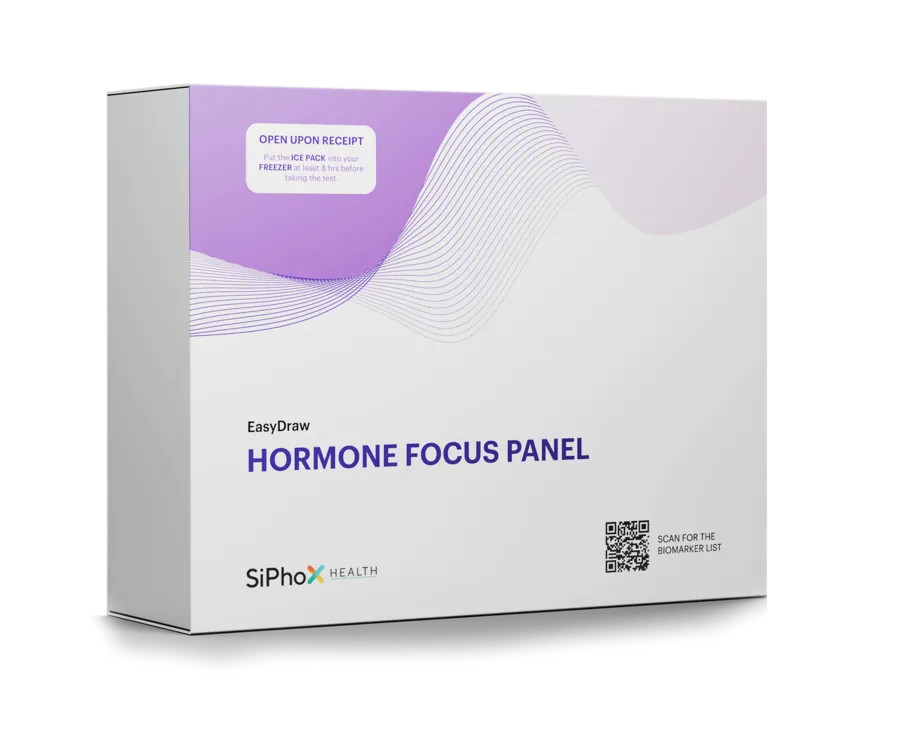
SiPhox Health measures progesterone on two panels: Hormone Focus, which SiPhox positions with progesterone for women and is included in the base $124 a test price, and Ultimate 360 (+$125 a test). Longevity Essentials, Heart & Metabolic, Thyroid Focus and GLP Optimization do not include it.
A home kit has one advantage here: you choose the collection day. If you want to confirm ovulation, plan your EasyDraw collection for the second half of your cycle and note the cycle day, since the result is meaningless without it. Hormone Focus also gives you estradiol, LH, FSH and the LH:FSH ratio in the same draw. Our at-home hormone test guide for women compares options.
A note on home samples: SiPhox's partner lab tests capillary blood collected from the upper arm. SiPhox says its results show a 95% to 99% correlation with venous draws in its own quarterly comparisons against Labcorp and Quest, but it has not published a study of the EasyDraw device. If a result would change a treatment decision, confirm it with a venous test through your doctor.
Hormone Focus
Sex hormones for men and women, including PSA for men and progesterone for women.
Check price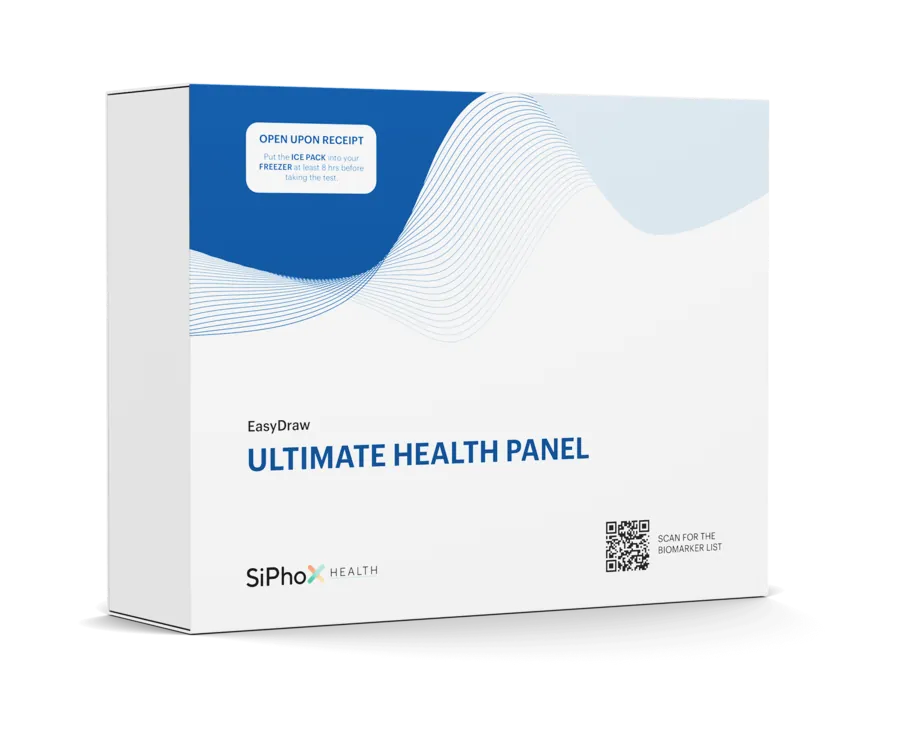
Ultimate 360
Everything on the four core panels plus iron studies, B12 and folate, GGT and PSA.
Check priceFrequently asked questions
What is a normal progesterone level?
It depends on timing: under 1 ng/mL before ovulation and 5 to 20 ng/mL mid-cycle, and under 1 ng/mL for men and after menopause (MedlinePlus). Pregnancy ranges are much higher.
What progesterone level confirms ovulation?
A clear rise in the second half of the cycle above the under 1 ng/mL seen before ovulation suggests you ovulated; MedlinePlus gives 5 to 20 ng/mL as the normal mid-cycle range. Your doctor will interpret it against your cycle day.
What causes low progesterone?
Most often not ovulating. MedlinePlus also lists PCOS, high stress, perimenopause, thyroid disorders, high prolactin and low cholesterol. In pregnancy, low levels can be linked to miscarriage or ectopic pregnancy.
Do men have progesterone?
Yes, in small amounts. Normal male levels are under 1 ng/mL (MedlinePlus) or 0.11 ng/mL or less on ARUP's mass spectrometry test.
Sources
- MedlinePlus Medical Encyclopedia: Serum progesterone
- MedlinePlus Lab Tests: Progesterone test
- ARUP Laboratories Test Directory: Progesterone quantitative by HPLC-MS/MS
- MedlinePlus Lab Tests: Follicle-stimulating hormone (FSH) levels test
- SiPhox Health: panel comparison (checked 29 Sep 2026)
- SiPhox Health: Hormone Focus panel